
Lecture video
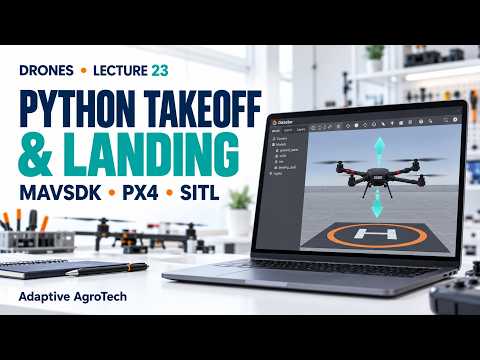
Video unavailable here? Watch on YouTube. Captions and playback speed are available in the player.
Study Lecture 23 | Drone Takeoff & Landing with Python | MAVSDK and PX4 Simulation. Use the accompanying model, numerical example and practical task to connect the topic to a measurable engineering result. Notes are original supplemental material, not a transcript.
Learning Objectives
- Explain the role of multirotor forces and constrained testing in the engineering system.
- Calculate the worked quantity with consistent units.
- Design a measurement that can reveal an implementation failure.
Study guide
Original companion notes. These notes support the topic of this lesson. They are not a transcript or a claim about the exact contents, hardware settings or examples in the video.
Lesson focus: Lecture 23 | Drone Takeoff & Landing with Python | MAVSDK and PX4 Simulation
Define the input, measured output, units and pass/fail condition before running the experiment.
Multirotor forces and constrained testing
A multirotor balances weight with thrust and controls attitude through thrust differences. Payload affects thrust margin, inertia and energy consumption. Use a simulator or restrained, controlled test setup before any free-flight experiment.
Model, units and assumptions
m is total mass, g ≈ 9.81 m/s² and n is rotor count. Equal thrust assumes level symmetric hover; maneuvering and disturbances require additional margin. This is not a complete sizing or flight-safety assessment.
Worked engineering example
A 2 kg quadrotor needs about 19.62 N total hover thrust, or 4.905 N per rotor under equal sharing. Battery voltage sag and propeller efficiency affect the actual operating point.
Practical task and evidence
Apply the following procedure to the topic of this lesson: Lecture 23 | Drone Takeoff & Landing with Python | MAVSDK and PX4 Simulation.
- Document mass, rotor geometry and the permitted test environment.
- Use simulation to inspect response to a small attitude command.
- Record thrust margin assumptions and keep all propeller-clearance controls in place.
Submit: a diagram or interface table, a short timestamped dataset, the calculation with units, and a paragraph explaining the largest observed limitation.
Check your understanding
Question. A symmetric 1.2 kg quadrotor hovers level. Estimate thrust per rotor.
Show worked answer
Approximately 2.943 N per rotor, ignoring aerodynamic interference and control margin.
Extension. Change one assumption in the model and explain which measurement would reveal that it no longer holds.