The Kalman Filter: Predict, Measure, Correct
A Kalman filter recursively predicts hidden state and uncertainty, then corrects them with measurements. Innovation and relative variances determine correction strength, while valid linear Gaussian assumptions underpin the stated estimation guarantee.
The key idea
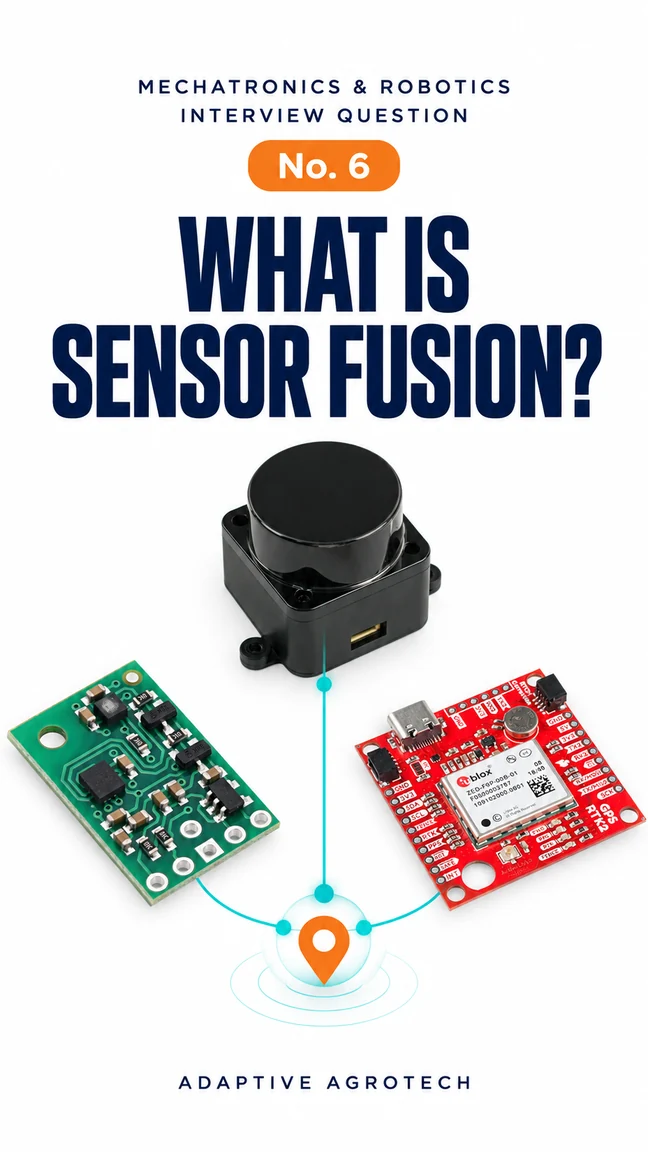
A Kalman filter maintains a state estimate and its uncertainty. A motion model predicts the next state, while process noise increases predicted variance. In the scalar example, predicted position is five metres and the sensor reads six, giving a one-metre innovation. Prediction variance of one and measurement variance of one quarter yield gain 0.8, corrected position 5.8 metres, and variance 0.2. The corrected result starts the next cycle. Under linear Gaussian assumptions, this recursion gives the optimal mean-squared estimate. Bias, outliers, or incorrect noise models can still produce an estimate that appears precise but is wrong.
What to remember
- Prediction advances both state and uncertainty.
- Innovation is measurement minus prediction.
- Relative uncertainties determine the measurement correction.
Check your understanding
What is the innovation when prediction is 5 m and measurement is 6 m?
Show the explanation
One metre: the measurement minus the predicted measurement.