Why Robots Need the Extended Kalman Filter
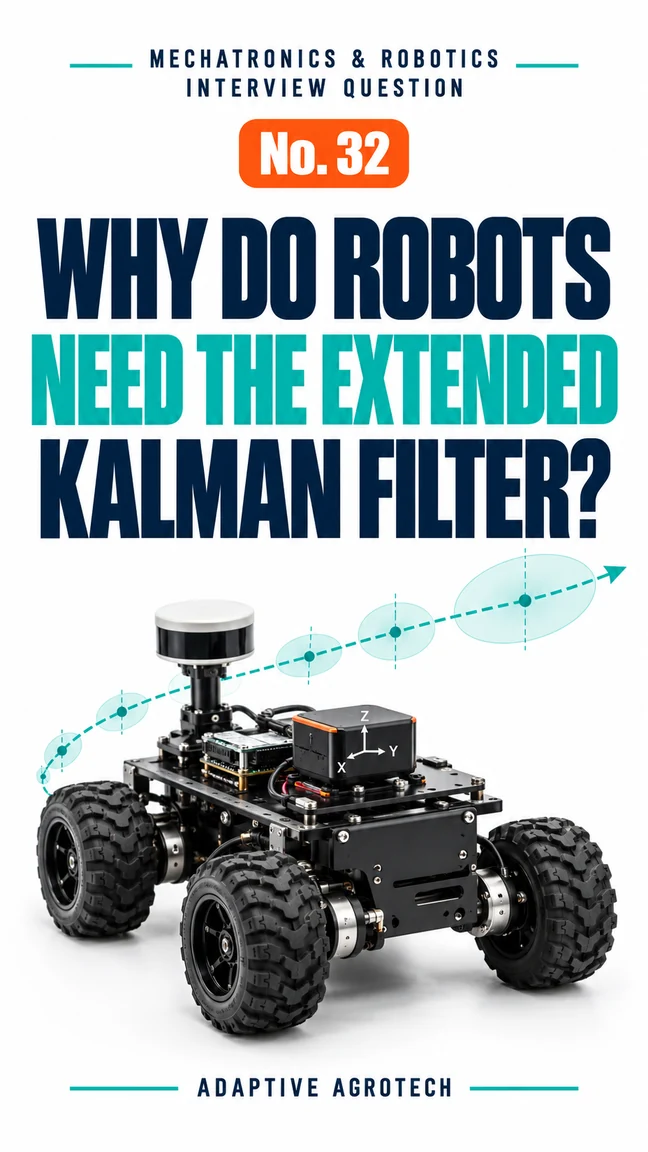
The extended Kalman filter predicts through nonlinear robot geometry and propagates uncertainty using local Jacobians. This approximation supports curved motion models but can fail with large uncertainty or poor initialization.
The key idea
A forward-moving robot's map displacement depends on heading through sine and cosine, making the motion relationship nonlinear. The EKF predicts its mean with that nonlinear function. It then linearizes around the current estimate to propagate covariance: a Jacobian expresses sensitivity to small changes in state. A nonlinear measurement model likewise uses its local Jacobian during correction. Modeled covariance can couple position and heading updates. Because the approximation is local, large uncertainty or a poor initial estimate can make it inaccurate. Residuals, initialization, and model assumptions must be checked rather than treating nonlinear prediction as a reliability guarantee.
What to remember
- The EKF mean follows nonlinear motion geometry.
- Jacobians approximate local uncertainty propagation and correction.
- Large errors can defeat a local linear approximation.
Check your understanding
What does a model Jacobian represent in an EKF?
Show the explanation
The local sensitivity of predicted quantities to small changes around the current estimate.