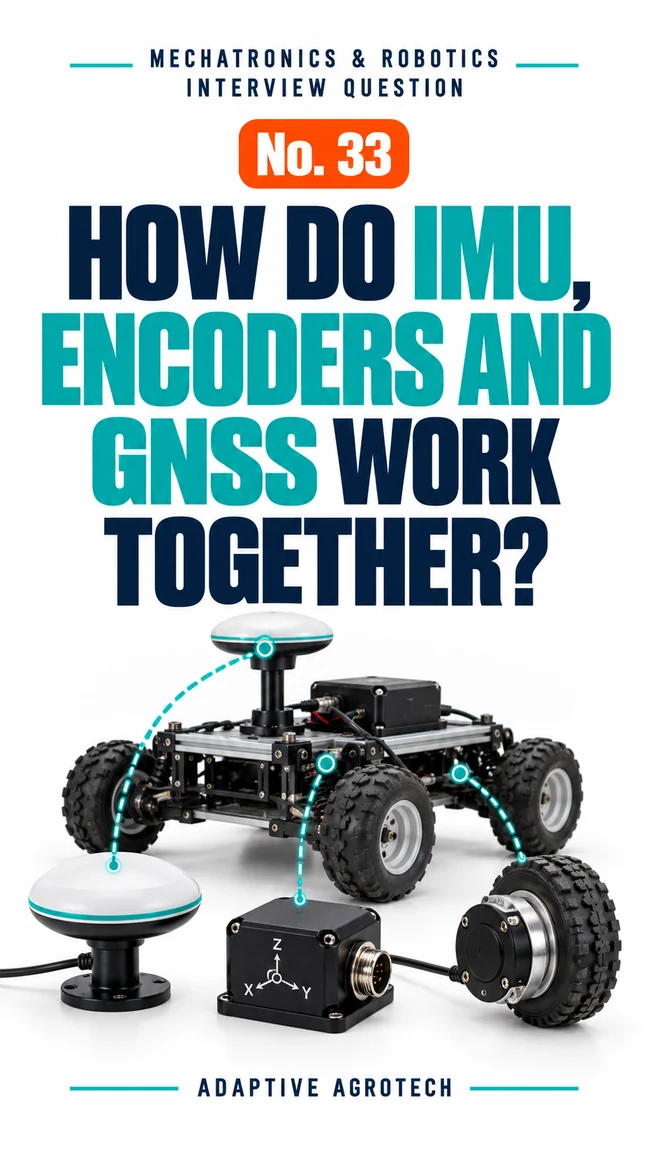
Sensor Fusion in Practice: IMU + Encoders + GNSS
Encoder, IMU, and GNSS fusion connects fast relative motion to geographic fixes. Useful estimation requires quality-aware corrections, compatible frames and timestamps, and care not to count correlated encoder information twice.
The key idea
Encoders contribute wheel motion, an IMU measures acceleration and rotation, and GNSS supplies geographic position. In the planar example, encoder speed and gyro turn rate propagate position and heading between slower satellite updates. Slip and bias still create drift, which valid GNSS fixes can reduce according to uncertainty. Degraded or inconsistent fixes should receive reduced confidence or rejection. Measurements need compatible frames and their actual timestamps; tuning cannot repair a sideways-mounted sensor modeled incorrectly or an old fix treated as current. Correlated inputs, such as encoder position and velocity derived from the same pulses, must not be treated as independent evidence.
What to remember
- Fast encoder and gyro updates bridge GNSS fixes.
- Coordinate and timing correctness precede filter tuning.
- Correlated measurements can produce false confidence if counted independently.
Check your understanding
Why can encoder position and velocity create double counting?
Show the explanation
Both may derive from the same pulses, so treating them as independent exaggerates the information available.