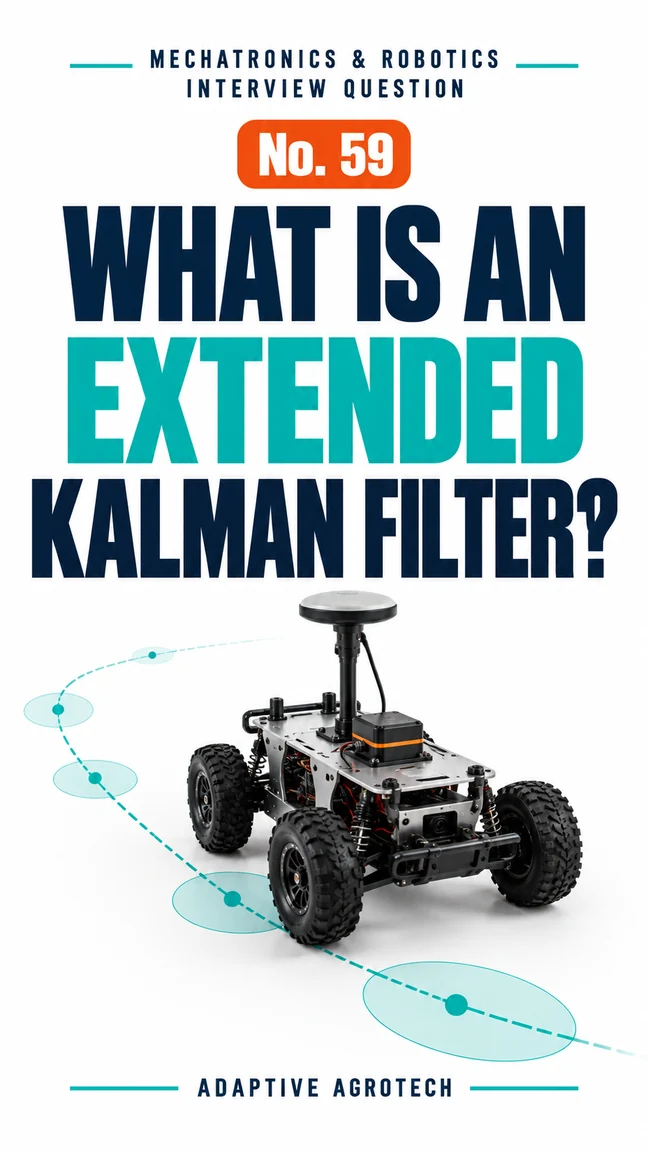
What is an Extended Kalman Filter?
The EKF uses nonlinear models for state prediction and Jacobians for local uncertainty handling. Heading-dependent robot motion is a typical application, with initialization and residual checks exposing failures of the local approximation.
The key idea
A moving robot's heading determines how forward travel divides between map coordinates through sine and cosine. The extended Kalman filter predicts using this nonlinear motion function rather than replacing the entire motion with a linear model. It uses a Jacobian, a local sensitivity matrix, to propagate uncertainty and form measurement corrections. This approach supports many robot estimators, but the approximation remains local to the estimated state. Large initial errors or strong nonlinear effects can make it inaccurate. Careful initialization and inspection of residuals help assess whether the local linearization is still describing the actual estimation problem adequately.
What to remember
- Nonlinear functions describe heading-dependent robot motion.
- Jacobians carry local sensitivity into estimation updates.
- Large initial errors can undermine local linearization.
Check your understanding
Why can poor initialization make an EKF unreliable?
Show the explanation
Its uncertainty calculations depend on a local approximation around the estimate, which may be inaccurate far from the true state.