What is Covariance in Robot Estimation?
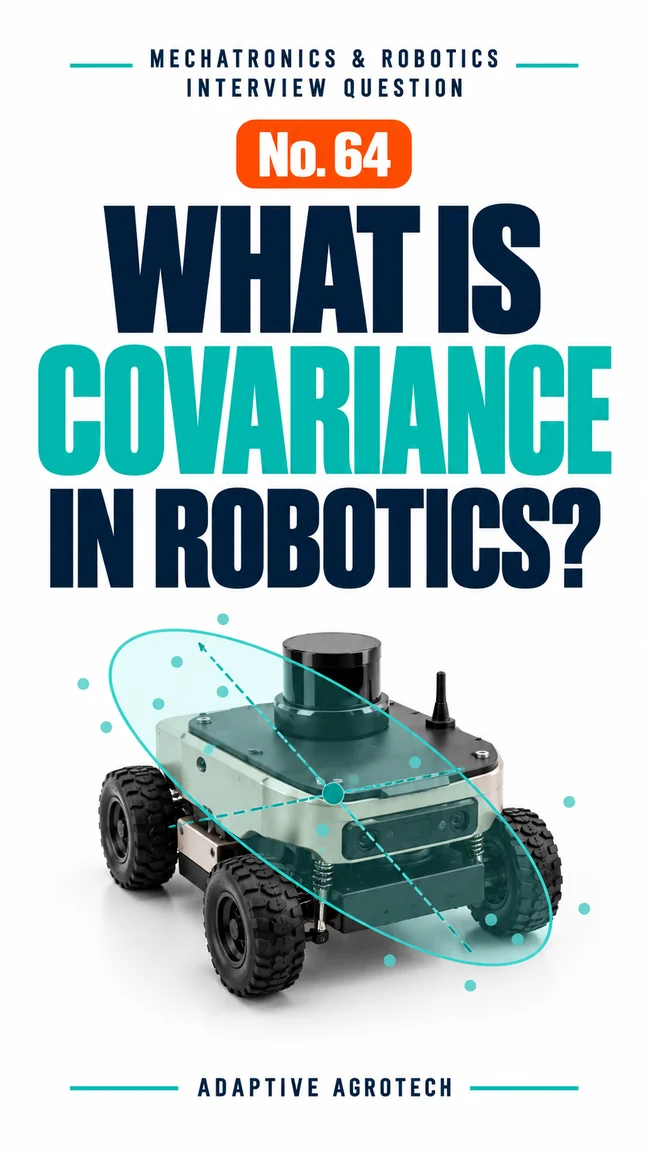
Covariance describes uncertainty magnitude and coupled estimation errors. Ellipse shape makes those relationships visible, while compatible frames, correct units, and credible values are essential before covariance is used to weight fusion.
The key idea
A covariance matrix describes how estimation errors vary together. For position, diagonal entries quantify spread along each axis, while off-diagonal entries represent coupled errors. A tilted uncertainty ellipse indicates that x and y errors tend to change together. Heading error can also influence position error after the robot turns, creating coupling between state components. Before fusion, covariance must match the measurement's coordinate frame and units. Small covariance expresses high claimed confidence, so unrealistically small values can cause a filter to trust poor data too strongly. Reported uncertainty should correspond to observed estimation error rather than merely look precise.
What to remember
- Diagonal entries describe variances; off-diagonal entries describe coupling.
- Tilted uncertainty ellipses indicate correlated position errors.
- Covariance values communicate confidence and must match units and frames.
Check your understanding
What does an unrealistically small measurement covariance imply to a filter?
Show the explanation
It claims excessive confidence, potentially making the filter trust poor measurements too strongly.