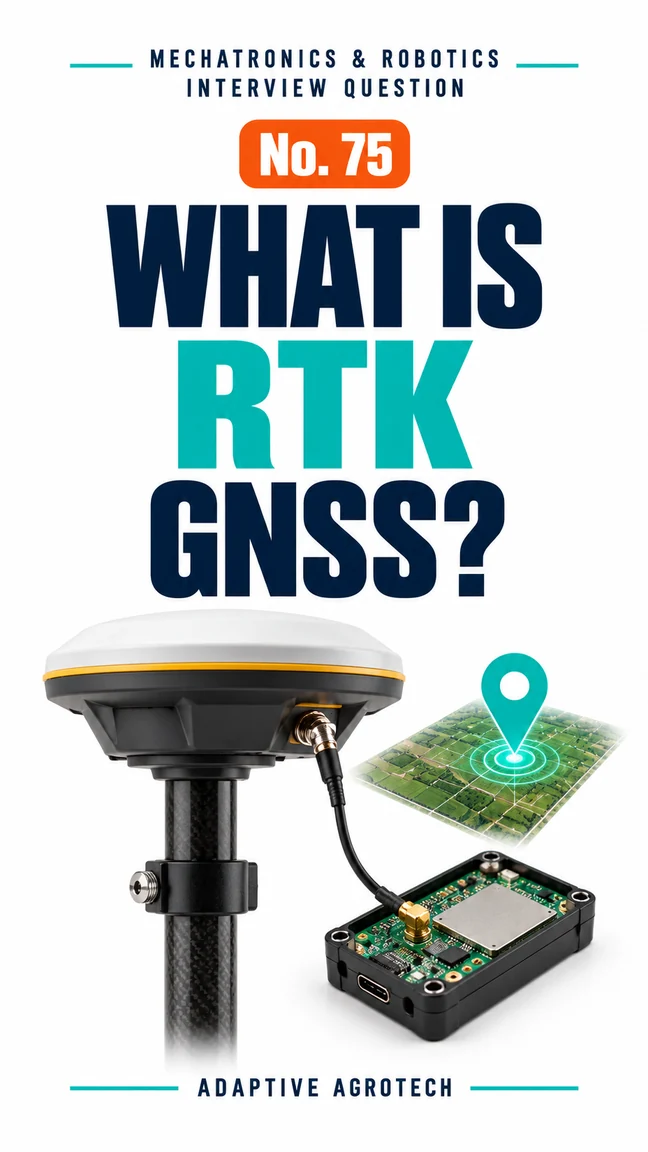
What is RTK GNSS?
RTK GNSS combines carrier-phase measurements with reference corrections for precise positioning. Resolving whole-cycle ambiguity supports centimetre-level fixed solutions under good conditions, while integrity checks remain necessary during actual robot motion.
The key idea
Real-time kinematic positioning uses satellite carrier-phase observations together with corrections from a reference station or network. The receiver must resolve the unknown whole number of carrier cycles. Under good conditions, a valid fixed solution can provide centimetre-level accuracy, supporting tasks such as following crop rows. Trees, reflected signals, and correction outages can still degrade performance. A reported fixed status is therefore one part of assessment rather than a guarantee that the position is correct. During motion, the system should monitor fix status, uncertainty, and consistency to judge whether the precise-looking output remains credible.
What to remember
- Reference corrections and carrier phase enable RTK positioning.
- Resolving carrier-cycle ambiguity supports a fixed solution.
- Fixed status still requires uncertainty and consistency monitoring.
Check your understanding
Does an RTK receiver reporting fixed guarantee a correct position?
Show the explanation
No. Reflections, obstruction, or other problems can still require integrity checks against uncertainty and consistency.