Read Engine RPM With an Arduino | OBD-II, CAN and an OLED
An Arduino can request the engine-speed parameter through OBD-II over a compatible CAN connection. The returned data bytes encode RPM and need decoding before display.
Watch & exploreExplore one engineering idea at a time. Watch a short lesson, read the key concepts and test your understanding before your next interview, project or class.
Video · Key ideas · Check your understanding
An Arduino can request the engine-speed parameter through OBD-II over a compatible CAN connection. The returned data bytes encode RPM and need decoding before display.
Watch & exploreA camera can classify visible tomato color as one indicator of maturity. The example assigns a red label with 92% confidence.
Watch & exploreA BME280 supplies temperature, humidity and pressure readings while a DS3231 clock supplies timestamps. An Arduino Nano presents the readings on a color display.
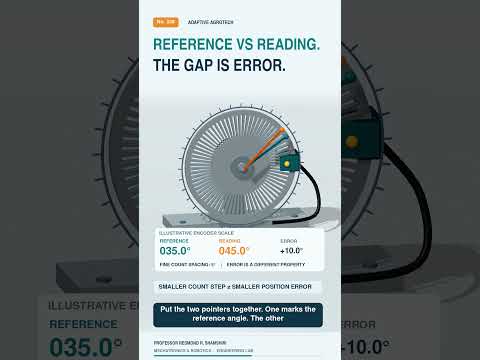
Watch & exploreEncoder resolution describes the smallest indicated increment. Accuracy describes how closely the reported position agrees with the true position.
Watch & exploreAn ESP32 can report a sensor alarm through an HTTPS messaging service. A persistent fault should generate a manageable number of texts.
Watch & exploreA load cell under a plant pot can track mass lost between waterings. An HX711 digitizes the small bridge signal for an Arduino Nano.
Watch & exploreRS-485, Modbus and CAN describe different aspects of machine communication. Identifying which layer a term refers to helps explain why devices may still be incompatible.
Watch & exploreA rear-facing camera can look for an approaching vehicle by tracking how its image changes over successive frames.
Watch & exploreA scanning LiDAR measures points at different times. If a robot moves during the sweep, a straight wall can appear bent in the assembled scan.
Watch & exploreA piezo sensor turns knocks on a desk into transient electrical signals. The Arduino recognizes a double knock by timing distinct events.
Watch & exploreA water-leak controller can drive a motorized valve closed and keep the system tripped until someone rearms it.
Watch & exploreA compatible alarm interface can repeat a carbon-monoxide alarm indication at another location. The primary alarm provides detection and its own warning.
Watch & explorePlanetary and harmonic gearboxes both reduce speed and increase available output torque. Their internal mechanisms produce different trade-offs in a robot joint.
Watch & exploreRain detection can request closure of a greenhouse vent. A limit switch can indicate the end of travel, while a latch retains the close request.
Watch & exploreA single tool pose can correspond to several valid joint configurations. An inverse-kinematics solver can switch branches between nearby target poses.
Watch & exploreA motor driver's permissible current depends on how effectively the system removes heat. A headline rating can assume cooling conditions different from those in the enclosure.
Watch & exploreA contact microphone senses vibration transmitted through a pump housing. Comparing that signal with a baseline can reveal changes in operation.
Watch & exploreA sensor can detect its target and light its indicator while the PLC still reads zero. The input needs a complete current path and a signal that meets its switching threshold.
Watch & exploreAn ESP32 can record how the received Wi-Fi signal from an access point changes along a route. Recording the channel alongside signal strength helps distinguish nearby networks.
Watch & exploreA 40 kHz acoustic signal lies above normal human hearing. An ultrasonic listener shifts information from that band into an audible range.
Watch & exploreAn end-of-line resistor gives a monitored cable a recognizable healthy resistance. The monitor can assign different resistance ranges to normal operation, an open circuit and a short.
Watch & exploreWater containing dissolved ions conducts between two probes. A transistor stage can use the small sensing current to control a relay coil.
Watch & exploreA compatible interface lets a smoke alarm signal an additional light. The alarm handles smoke detection and its primary warning, while the accessory controls the light.
Watch & exploreA separate high-level float can interrupt tank filling if the normal level control fails. A latched trip keeps the fill command disabled after the surface drops below the float.
Watch & explore