What Is a Robot Arm’s Workspace?
A robot arm’s workspace contains the positions its tool can reach under its joint limits. Some positions allow only a restricted set of tool orientations.
Watch & exploreExplore one engineering idea at a time. Watch a short lesson, read the key concepts and test your understanding before your next interview, project or class.
Video · Key ideas · Check your understanding
A robot arm’s workspace contains the positions its tool can reach under its joint limits. Some positions allow only a restricted set of tool orientations.
Watch & exploreTwo arms sharing a workcell need trajectories that account for where both robots will be at each instant. Their links, tools and carried objects all occupy space.
Watch & exploreA BLE tag sends radio advertisements that an ESP32 can observe. A separation reminder can use a filtered signal trend and the time since the last advertisement to decide when to alert.
Watch & exploreA path describes the geometry a robot should follow. A trajectory assigns times to positions along that path, defining how the motion unfolds.
Watch & exploreA single-pole double-throw relay moves its common contact between two branches. Grouping four lamps into two banks lets the relay select which bank is connected.
Watch & exploreWireless sensor links differ in data rate, energy demand and network structure. A phone accessory, a building mesh and a field station impose different communication requirements.
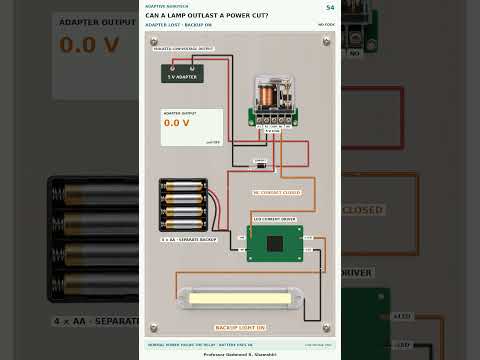
Watch & exploreA transfer relay can select battery power for a lamp when its normal supply fails. The useful backup time depends on the battery’s available energy and the lamp’s power draw.
Watch & exploreA passive NFC tag can carry a link to a wallet return-contact page. A nearby compatible phone energizes the tag during a scan and reads its stored data.
Watch & exploreA joystick supplies two analog commands for pan and tilt. The ESP32 reads each axis and sends the corresponding servo pulse settings to a PCA9685 over I²C.
Watch & exploreA conveyor checkweigher needs a stable weight reading and a way to associate the result with the item that reaches the reject station.
Watch & exploreA camera locates an object in an image, but a servo arm needs a reachable target in its own coordinate system.
Watch & exploreA differential-drive robot can respond to an obstacle by changing the speeds of its left and right wheels. An ESP32 can coordinate that local response.
Watch & exploreA Pico and DRV8825 can move a stepper axis toward a home switch to establish a repeatable position reference.
Watch & exploreAn ESP32 weather station can combine BME280 temperature, relative humidity and pressure readings with separate wind and rainfall measurements.
Watch & exploreA Raspberry Pi can pair SHT31 temperature and humidity readings with timestamps from a DS3231 clock and store each sample as a CSV row.
Watch & exploreA PLC can detect a possible motor jam from sustained overcurrent and latch a trip until an operator resets it.
Watch & exploreAn Arduino ultrasonic parking guide converts echo travel time into distance bands shown by LEDs. Hysteresis helps the display stay stable near a boundary.
Watch & exploreEncoder feedback lets an Arduino compare measured motor speed with the target and adjust drive after a load change.
Watch & exploreAn Arduino and a PLC can both send step and direction commands to a suitable drive. Using the same NEMA 17 motor makes the controller’s role easier to isolate.
Watch & exploreThe Seeed Studio XIAO family puts different processors and peripherals into a compact board format. Compare the interfaces, wireless features and memory a project needs before choosing a board.
Watch & exploreAn Arduino can provide a speed request through a suitable 0–10 V interface to a variable-frequency drive. The drive supplies and controls the AC motor that turns the fan.
Watch & exploreA garden robot has a power path that supplies energy and a signal path that carries observations and motion commands. Tracing both explains how a controller can be running while a motor remains still.
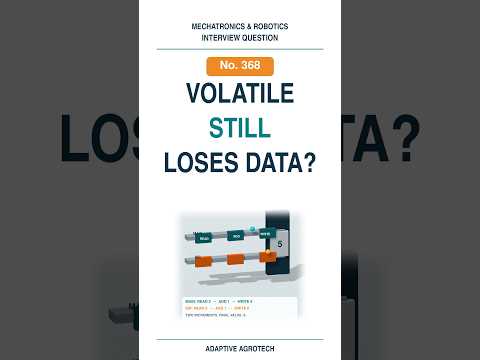
Watch & exploreA volatile qualifier makes the compiler perform accesses to a shared variable.
Watch & exploreA long button cable adds capacitance and picks up electrical interference.
Watch & explore