Fridge Door Left Open? Build a 20-Second Arduino Alarm
A door switch gives an Arduino a simple timing problem. The alarm sounds only when the fridge door stays open for 20 continuous seconds.
Watch & exploreExplore one engineering idea at a time. Watch a short lesson, read the key concepts and test your understanding before your next interview, project or class.
Video · Key ideas · Check your understanding
A door switch gives an Arduino a simple timing problem. The alarm sounds only when the fridge door stays open for 20 continuous seconds.
Watch & exploreAn Arduino can request motion from a hydraulic valve by sending an electrical command. The command, the coil drive and the hydraulic flow each play a different role.
Watch & exploreAn Arduino Nano uses an MQ-2 reading to switch a fan through a relay. Separate switching thresholds keep small fluctuations from repeatedly cycling the fan.
Watch & exploreA 433 MHz radio link turns a button press into a message for a remote Arduino. A receiver timeout gives the LED a defined state when a release message is lost.
Watch & exploreA water sensor under a sink detects a drip when conductive water bridges its exposed traces. An Arduino turns the resulting signal into a light and buzzer alert.
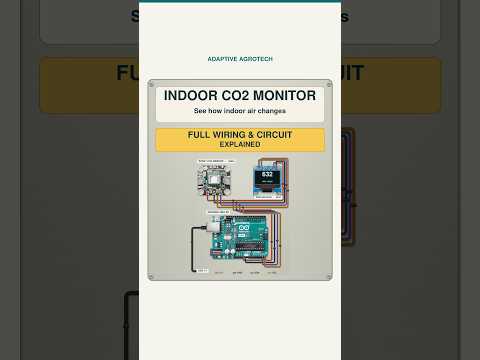
Watch & exploreAn SCD41 and an Arduino can track how indoor carbon dioxide changes after a window opens. A time series helps distinguish a trend from a single reading.
Watch & exploreAn accelerometer on a washer cabinet can detect motion and quiet periods. An Arduino uses the duration of a quiet period to infer when a cycle has probably ended.
Watch & exploreAn Arduino can request the engine-speed parameter through OBD-II over a compatible CAN connection. The returned data bytes encode RPM and need decoding before display.
Watch & exploreAn Arduino waits until an object remains within 40 cm of the distance sensor for two seconds before sending an infrared PAUSE command. It sends one command per approach.
Watch & exploreAn Arduino Nano uses a rain indication to command a servo that closes a miniature clothesline cover.
Watch & exploreA BME280 supplies temperature, humidity and pressure readings while a DS3231 clock supplies timestamps. An Arduino Nano presents the readings on a color display.
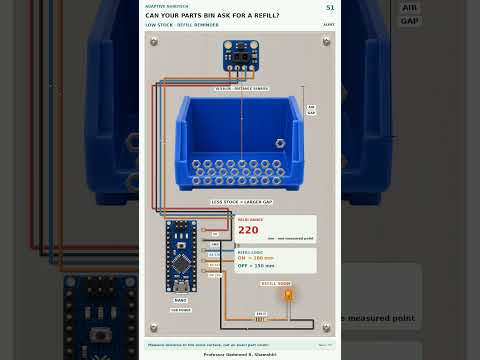
Watch & exploreA VL53L0X range sensor lets an Arduino Nano monitor the gap above a parts pile. An increasing gap can indicate that a bin needs refilling.
Watch & exploreA load cell under a plant pot can track mass lost between waterings. An HX711 digitizes the small bridge signal for an Arduino Nano.
Watch & exploreA piezo sensor turns knocks on a desk into transient electrical signals. The Arduino recognizes a double knock by timing distinct events.
Watch & exploreAn Arduino model barrier can use vehicle detection to inhibit a closing command while the passage is occupied. The servo command and the occupancy signal describe different parts of the sequence.
Watch & exploreA DS3231 supplies the wall-clock time for an Arduino grow-light schedule. A MOSFET switches the lighting load according to whether the current time falls inside the programmed interval.
Watch & exploreAn Arduino ultrasonic parking guide converts echo travel time into distance bands shown by LEDs. Hysteresis helps the display stay stable near a boundary.
Watch & exploreEncoder feedback lets an Arduino compare measured motor speed with the target and adjust drive after a load change.
Watch & exploreAn Arduino can use ultrasonic distance to a liquid surface to decide when a tank needs refilling. The air gap decreases as the tank fills.
Watch & exploreAn Arduino thermostat can read a DS18B20 temperature sensor and control a fan with separate switch-on and switch-off temperatures.
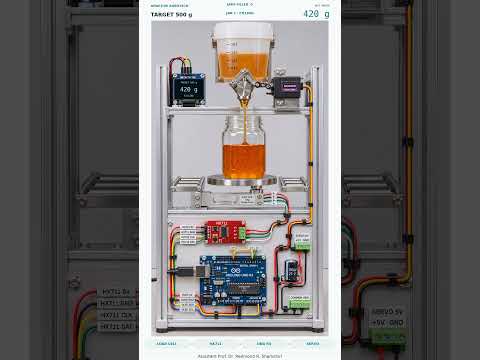
Watch & exploreAn Arduino honey filler can use a scale to target 500 g of net product and coordinate the weighing, filling and completion stages.
Watch & exploreAn Arduino and a PLC can both send step and direction commands to a suitable drive. Using the same NEMA 17 motor makes the controller’s role easier to isolate.
Watch & exploreAn Arduino can provide a speed request through a suitable 0–10 V interface to a variable-frequency drive. The drive supplies and controls the AC motor that turns the fan.
Watch & exploreBoth an Arduino and a PLC can compare measured brushless-motor speed with a reference and command a drive.
Watch & explore