
Lecture video
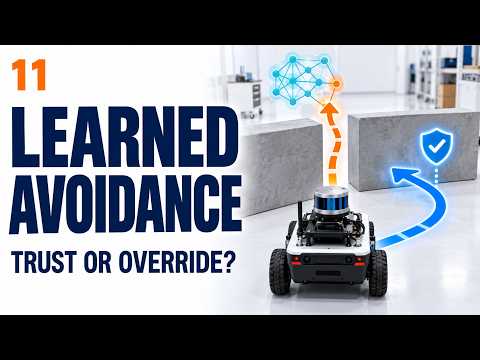
Video unavailable here? Watch on YouTube. Captions and playback speed are available in the player.
Study Collision Avoidance 11 | Learned Avoidance: Behavior Cloning with Independent Validation. Use the accompanying model, numerical example and practical task to connect the topic to a measurable engineering result. Notes are original supplemental material, not a transcript.
Learning Objectives
- Explain the role of learning-based control and independent evaluation in the engineering system.
- Calculate the worked quantity with consistent units.
- Design a measurement that can reveal an implementation failure.
Study guide
Original companion notes. These notes support the topic of this lesson. They are not a transcript or a claim about the exact contents, hardware settings or examples in the video.
Lesson focus: Collision Avoidance 11 | Learned Avoidance: Behavior Cloning with Independent Validation
Define the input, measured output, units and pass/fail condition before running the experiment.
Learning-based control and independent evaluation
A learned policy can exploit patterns in a training environment that disappear on real hardware. Keep training, tuning and final evaluation separate. A reward is an optimization target, not a complete statement of operational safety or task quality.
Model, units and assumptions
This is the tabular Q-learning update: α is learning rate, γ discount, r immediate reward and s′ next state. The formula does not supply safe exploration or solve model mismatch.
Worked engineering example
For old Q = 2, reward = 1, next maximum Q = 3, γ = 0.9 and α = 0.1, new Q is 2 + 0.1(1+2.7−2) = 2.17.
Practical task and evidence
Apply the following procedure to the topic of this lesson: Collision Avoidance 11 | Learned Avoidance: Behavior Cloning with Independent Validation.
- Define the allowed state/action region and a separate action constraint monitor.
- Evaluate held-out scenarios and document failed episodes as well as average return.
- Compare task success, constraint violations and recovery behavior with a simple baseline.
Submit: a diagram or interface table, a short timestamped dataset, the calculation with units, and a paragraph explaining the largest observed limitation.
Check your understanding
Question. Old Q = 1, reward = 0, next max Q = 2, γ = 0.5, α = 0.2. Find the update.
Show worked answer
It remains 1 because the temporal-difference error is zero.
Extension. Change one assumption in the model and explain which measurement would reveal that it no longer holds.
Summary
Suggested Reading & Resources
- ReadingMathWorks control-system modelingOpen ↗
Primary documentation or original technical reference; check the version used in your lab.