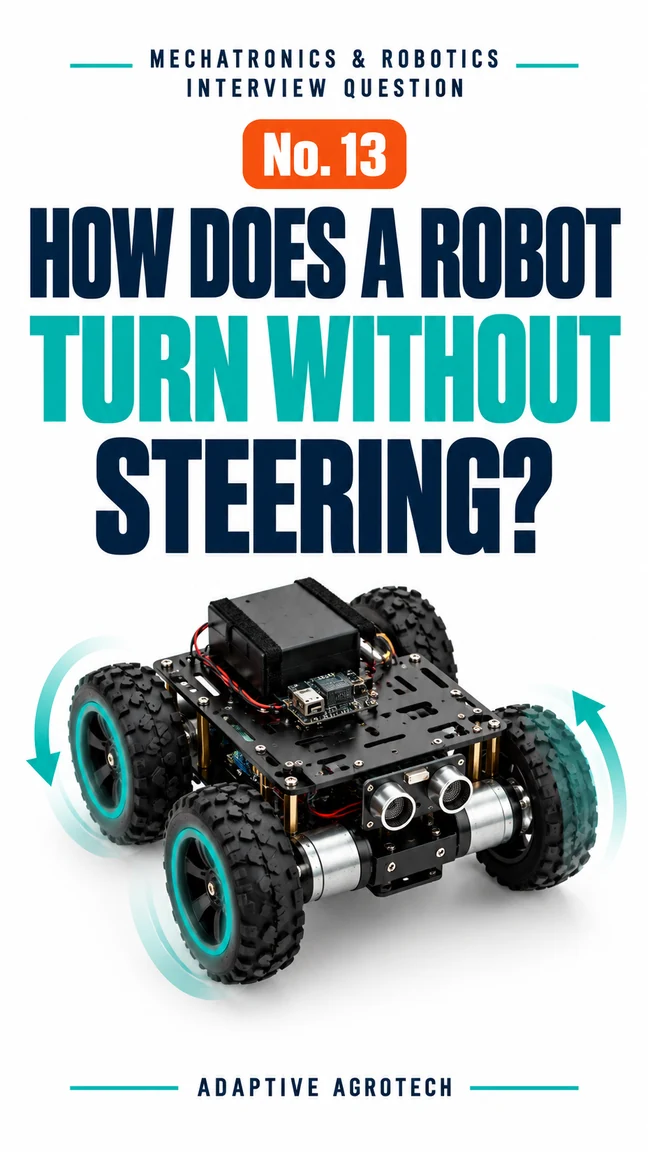
How a Robot Turns Without a Steering Wheel
Differential drive steers by changing the speeds of two independently driven wheels. Their average sets forward motion and their difference sets yaw, with ideal relationships depending on rolling contact and traction.
The key idea
Two driven wheels let a differential-drive robot translate and rotate without a steering mechanism. With equal wheel sizes and no slip, forward speed is \(v=(v_R+v_L)/2\), while yaw rate is \(\omega=(v_R-v_L)/b\), where \(b\) is wheel separation. Equal forward speeds produce straight travel. A faster right wheel produces a leftward arc; equal and opposite speeds rotate about the centre with zero forward speed. Unequal diameters, uneven surfaces, and slip violate the ideal model. Encoder feedback regulates wheel rotation, while independent sensing helps check the robot's actual ground motion.
What to remember
- Average wheel speed determines ideal forward speed.
- Wheel-speed difference and separation determine ideal yaw rate.
- Equal opposite wheel speeds allow rotation in place.
Check your understanding
What happens when wheel speeds are equal in magnitude and opposite in direction?
Show the explanation
The ideal robot rotates in place with zero average forward speed.