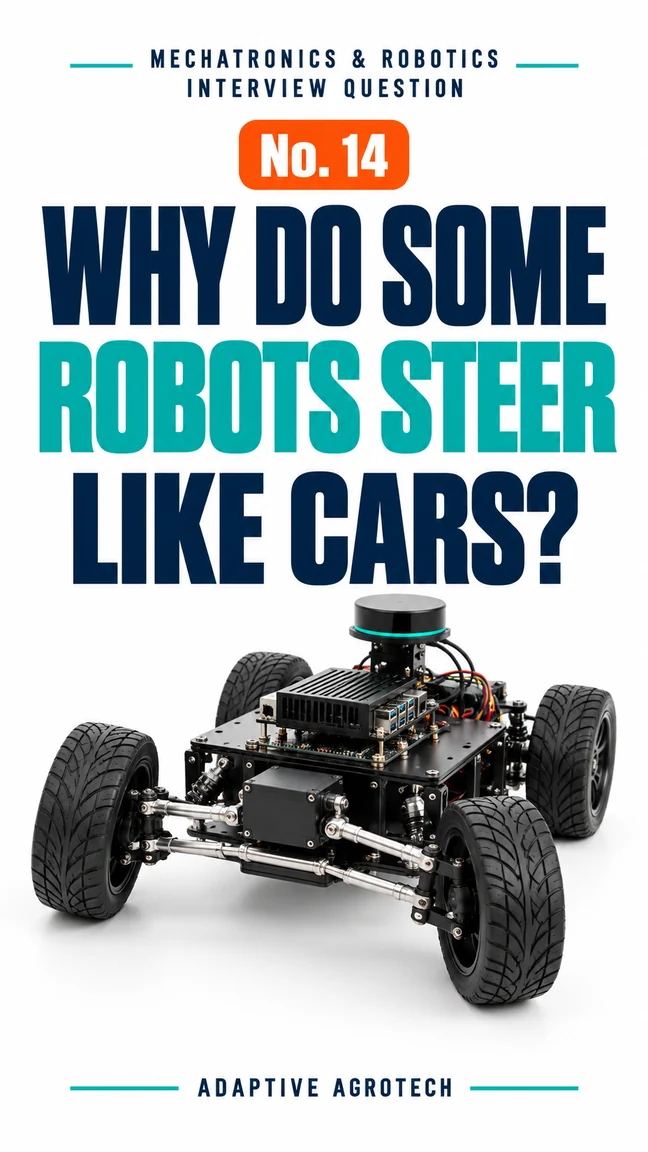
Why Some Robots Steer Like Cars
Car-like steering follows curved rolling paths. Ackermann geometry turns the inside wheel more sharply, while wheelbase and steering limits determine turning radius and constrain the manoeuvres a planner can request.
The key idea
A car-like robot turns by changing front-wheel direction while the rear wheels remain aligned with the body. The inside front wheel follows a smaller circle and needs a larger steering angle. Ideal Ackermann geometry makes lines perpendicular to wheel rolling directions meet at one instantaneous turning centre. A bicycle approximation combines each axle into one virtual wheel and gives \(R=L/\tan\delta\). Longer wheelbase or smaller steering angle increases radius. Such a robot cannot ordinarily rotate in place, so tight manoeuvres may require reversing. At higher speeds, tyre slip limits this simple geometric model.
What to remember
- The inside front wheel needs a larger steering angle.
- Bicycle-model radius depends on wheelbase and steering angle.
- Planning must respect turning limits and manoeuvring space.
Check your understanding
Why does the inside front wheel steer through a larger angle?
Show the explanation
It follows a smaller turning circle, so the wheel directions need different angles to share a turning centre.