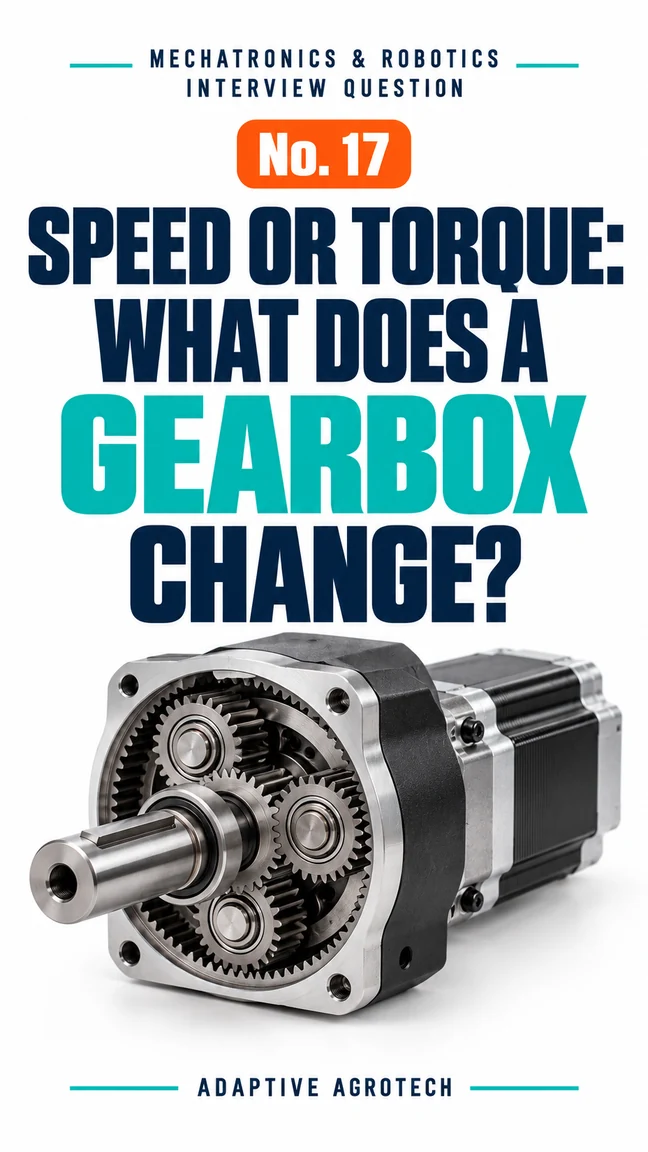
Speed or Torque? What a Robot’s Gearbox Changes
A reduction gearbox trades motor speed for output torque, with efficiency reducing the ideal torque gain. Wheel radius, gearbox limits, and backlash determine how that operating point translates into useful robot motion.
The key idea
A motor can rotate faster than the wheel requires, so reduction gearing moves its operating point toward lower speed and greater torque. A ten-to-one reduction converts an illustrative 3,000 rpm input to 300 rpm output. Ideal torque scales with ratio, but real friction reduces the gain: 0.1 Nm multiplied by ten and 80 percent efficiency gives 0.8 Nm. Approximate ground force is wheel torque divided by radius, subject to traction. Greater reduction lowers maximum speed, and gearbox torque ratings and backlash also matter. Selection therefore considers the motor and gearbox together against speed and continuous-load requirements.
What to remember
- Reduction lowers speed while increasing available output torque.
- Efficiency reduces torque gain below the ideal ratio.
- Wheel radius, backlash, and torque limits affect practical performance.
Check your understanding
What output torque results from 0.1 Nm, 10:1 reduction, and 80% efficiency?
Show the explanation
Approximately 0.8 Nm, using input torque × reduction ratio × efficiency.