How Pure Pursuit Keeps a Robot on Its Path
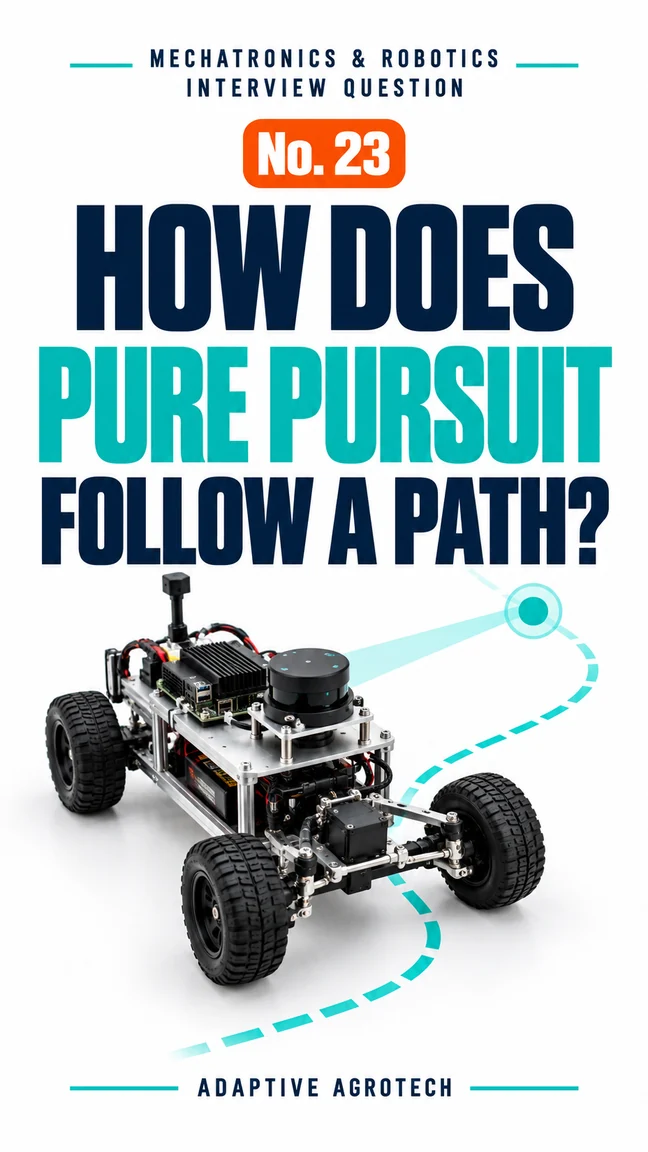
Pure pursuit tracks a path by steering toward a moving look-ahead target. Target geometry sets curvature and yaw rate, while look-ahead trades responsiveness against smoothness and does not replace obstacle checking.
The key idea
Pure pursuit uses a planned path and estimated robot pose to choose a target ahead of the robot. In robot coordinates, an arc tangent to the current heading passes through that point. Curvature is twice its lateral offset divided by squared target distance. For differential drive, forward speed multiplied by curvature gives yaw rate, which becomes wheel-speed commands. A shorter look-ahead responds more strongly but may oscillate; a longer one smooths steering while cutting corners more. Look-ahead should suit speed and motion limits. The controller still needs collision checking, speed limits, and stopping or replanning if the path becomes unsafe.
What to remember
- A moving look-ahead target determines the tracking arc.
- Curvature and forward speed determine yaw-rate demand.
- Pure pursuit does not independently plan obstacle avoidance.
Check your understanding
What tradeoff follows from increasing look-ahead distance?
Show the explanation
Steering generally becomes smoother, but tracking cuts corners more and responds less strongly to nearby path changes.