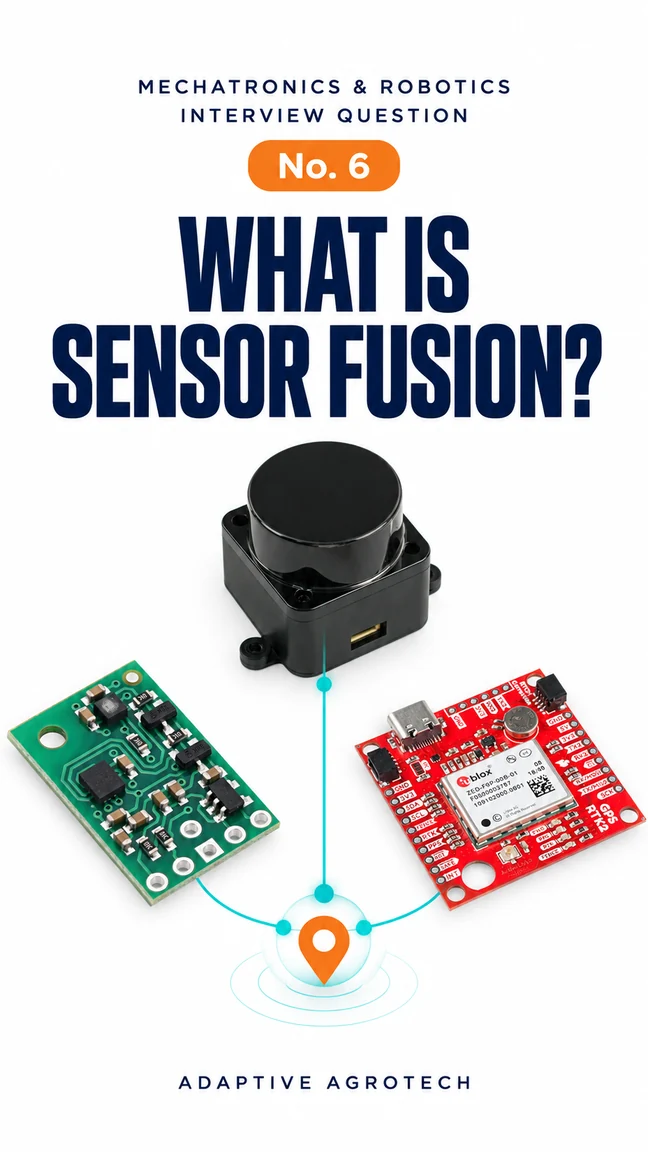
What is Sensor Fusion?
Sensor fusion estimates one shared state from complementary measurements. Fast wheel and gyro updates bridge position fixes, while sound timing, frames, uncertainty, and correlation handling prevent misleading confidence in the fused result.
The key idea
A mobile robot can combine wheel speed, gyro turn rate, and satellite position to constrain a common state. Wheel and gyro measurements predict motion between slower position fixes. A suitable external fix then limits drift, with its correction strength determined by modeled uncertainty. These readings must first refer to compatible coordinate frames and measurement times. More inputs do not necessarily provide more independent information: two readings calculated from the same encoder pulses share errors. Treating them as separate independent evidence can make the state estimate overconfident, even when the output looks consistent and smooth.
What to remember
- Complementary observations constrain a shared robot state.
- Fast motion data predicts between external position updates.
- Shared source data must not be counted as independent evidence.
Check your understanding
Why can two encoder-derived readings make fusion overconfident?
Show the explanation
They share underlying pulse errors, so treating them as independent exaggerates the available information.