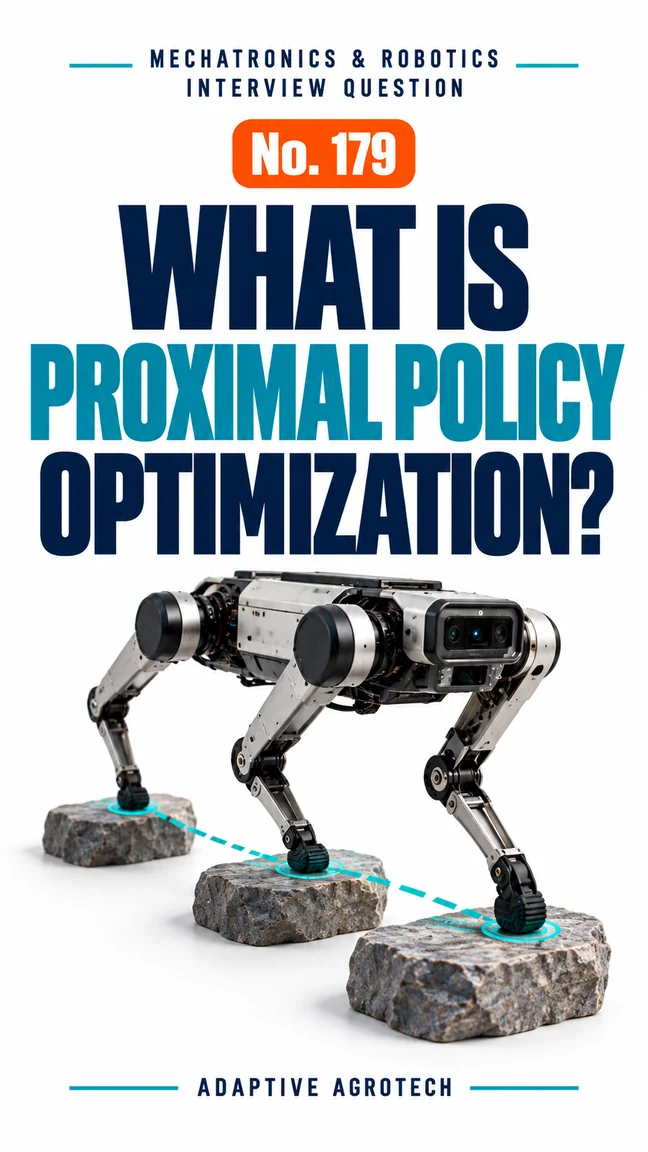
What Is Proximal Policy Optimization, or PPO?
PPO means proximal policy optimization. Its common clipped version improves a stochastic policy using recent experience. A probability ratio compares how likely an action is under the new and old policies.
The key idea
PPO means proximal policy optimization. Its common clipped version improves a stochastic policy using recent experience. A probability ratio compares how likely an action is under the new and old policies.
For a simulated walking robot, a positive advantage favors increasing the probability of a useful action. The clipped objective stops rewarding that increase beyond a chosen ratio, such as one point two.
This clipping does not guarantee that every policy change stays small. PPO still needs suitable learning rates, fresh rollouts, and performance checks. It provides no automatic collision or stability guarantee.
What to remember
- Compare new and old action probabilities
- Clipping limits the surrogate incentive
- PPO clipping is not a hard constraint
Check your understanding
Does PPO clipping guarantee every policy update stays small or safe?
Show the explanation
No. Clipping limits a surrogate objective's incentive, rather than imposing a hard safety constraint on every update. Learning rates, rollout quality and deployment checks remain necessary.