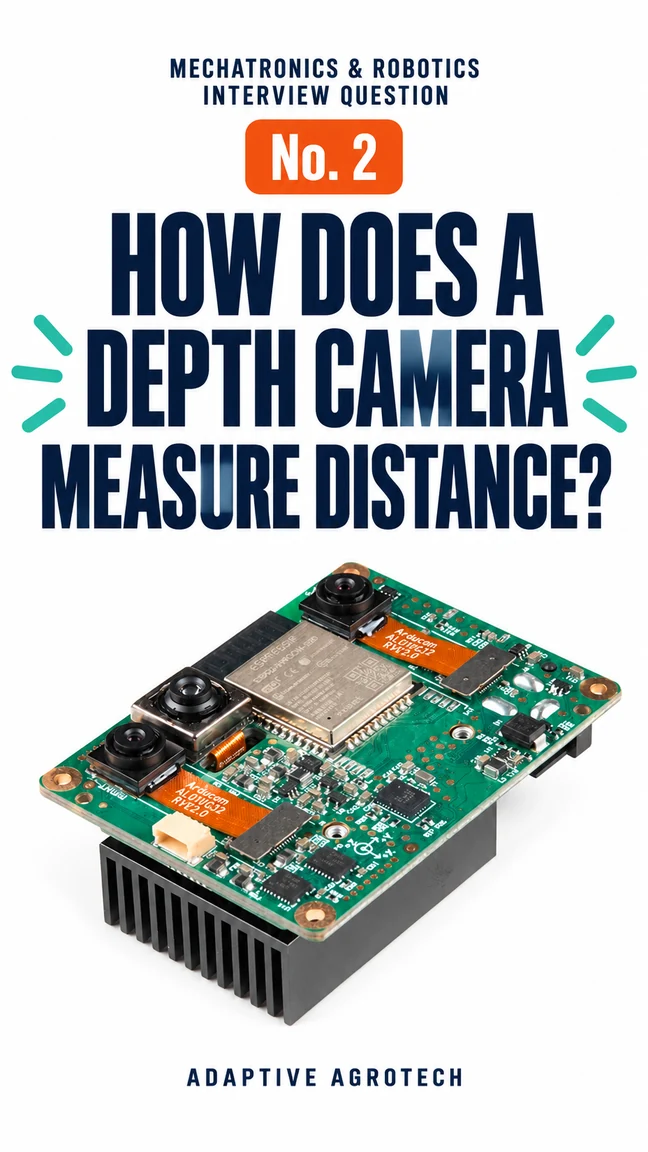
How a Depth Camera Measures Distance
Stereo depth uses the disparity between two camera views to estimate distance. Calibration connects pixel displacement to geometry, and unreliable matches must remain unknown when forming obstacle estimates.
The key idea
A stereo camera observes a scene from two separated viewpoints. Matching features shift horizontally between images; this disparity generally grows as objects approach. With calibrated focal length \(f\), baseline \(B\), and disparity \(d\), depth is \(Z=fB/d\). The presentation's illustrative values, 400 pixels, 0.10 metres, and 40 pixels, yield one metre. Featureless walls, reflections, and occlusion can make matches unreliable. Invalid pixels must remain unknown. Valid depth becomes three-dimensional points that help check the robot's planned volume with appropriate obstacle clearance.
What to remember
- Stereo depth depends on matching features across two viewpoints.
- Greater disparity usually indicates a closer object.
- Invalid depth describes uncertainty rather than empty space.
Check your understanding
What should a robot infer from an invalid depth pixel?
Show the explanation
That depth is unknown; it cannot safely infer that the region is clear.