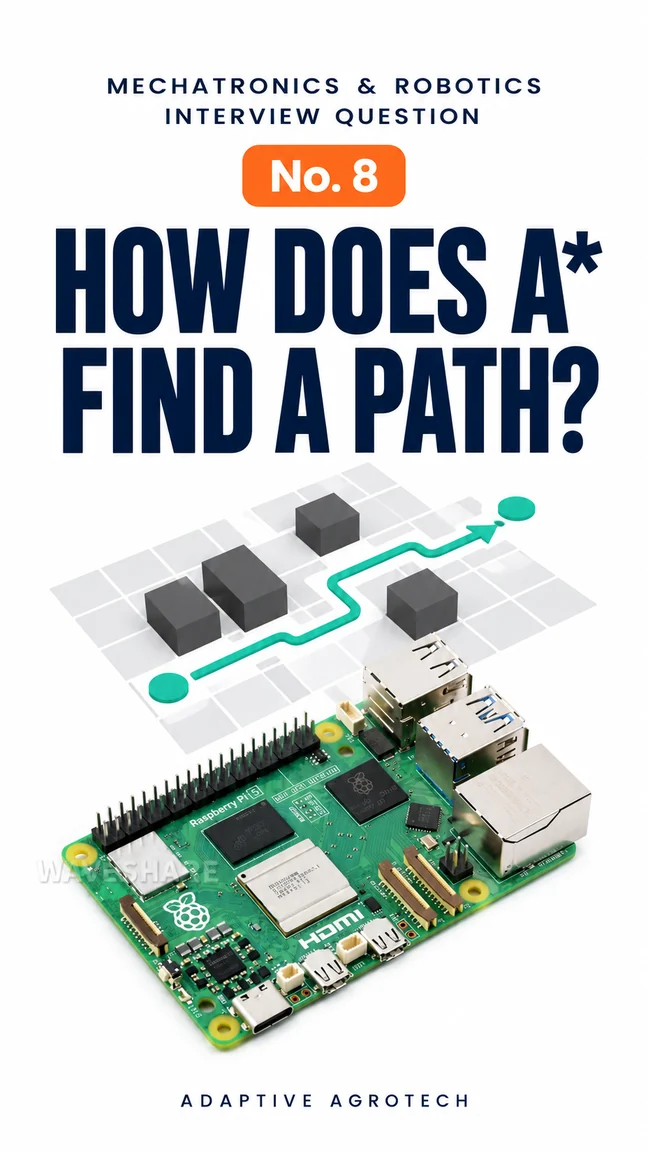
How A* Finds a Path Around Obstacles
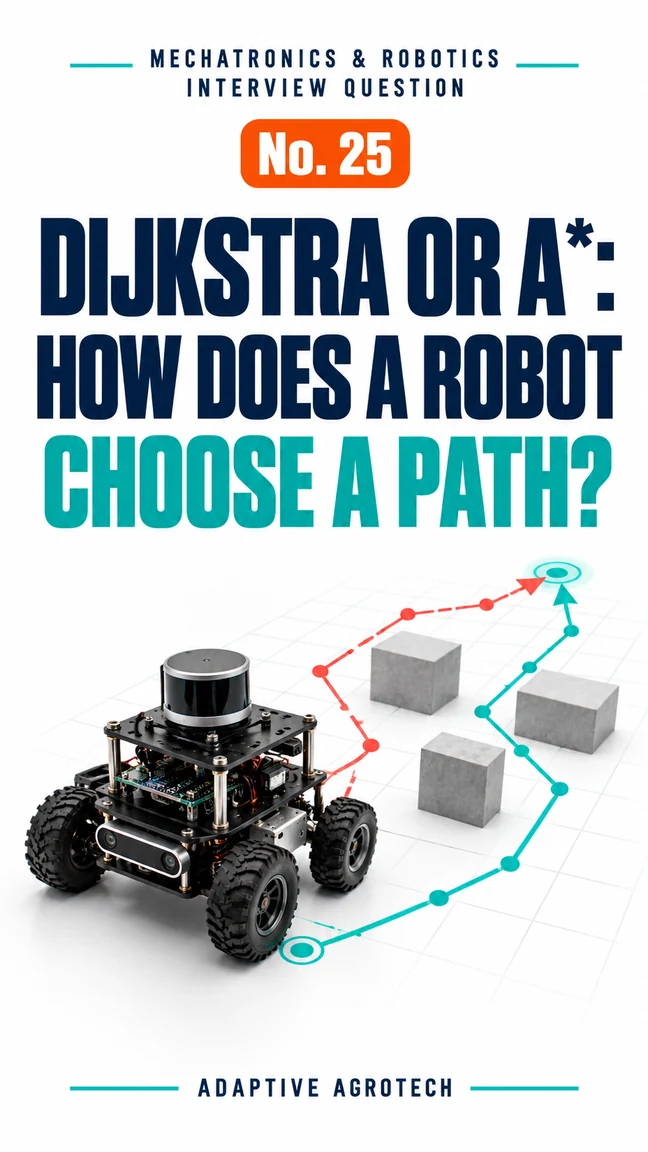
A* searches a graph by combining traveled cost with estimated remaining cost. It reconstructs a route through parent links, while physical navigation still needs footprint clearance, control, and updated sensing.
The key idea
A* receives a map, start, and goal. Obstacles need clearance margins that represent the robot's body. Each candidate is scored using \(f=g+h\): traveled cost plus estimated remaining cost. In the presentation's four-neighbor example, the estimate is Manhattan distance. The algorithm expands the lowest-scoring candidate, checks free neighbors, and retains better routes. Parent links reconstruct the path after reaching the goal. Suitable costs and an admissible heuristic support a least-cost graph path, but a controller must execute it and fresh obstacles still require updated sensing and planning.
What to remember
- A* ranks candidates with traveled cost plus heuristic estimate.
- Stored parent links reconstruct the graph path.
- A planned path still requires control and collision-aware updates.
Check your understanding
What do g and h represent in A*?
Show the explanation
g is cost already traveled; h estimates the remaining cost to the goal.