How a Robot Avoids an Obstacle That Suddenly Appears
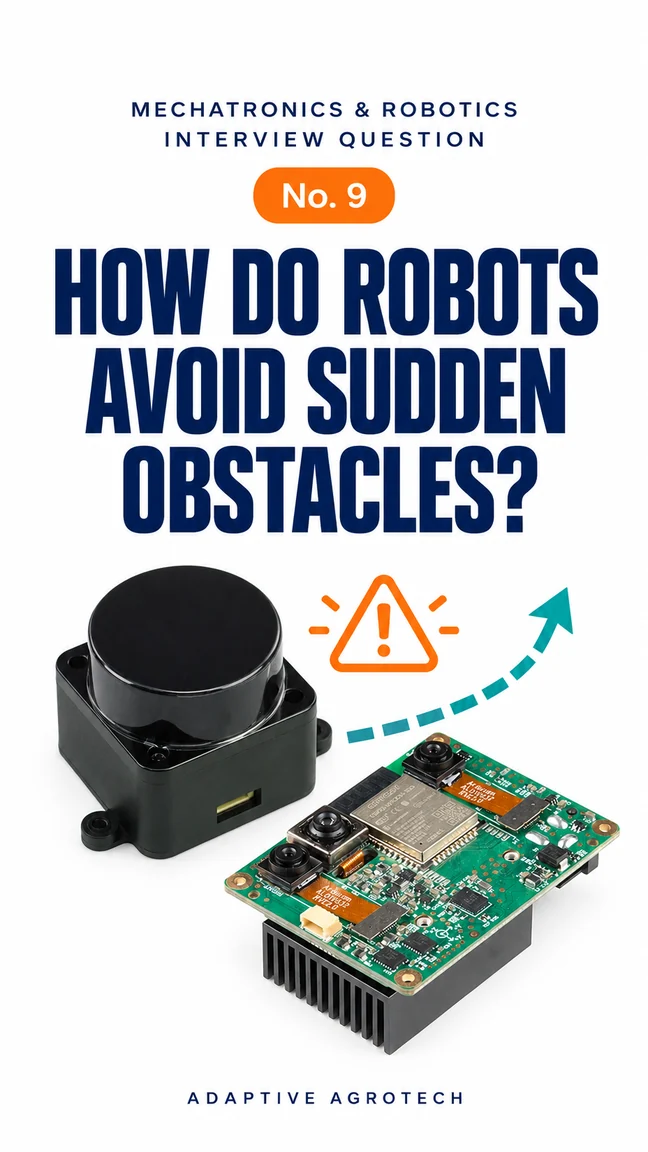
When an obstacle appears, local planning updates the obstacle map and tests feasible short motions. Footprint collision checks and repeated sensing guide avoidance; stopping remains necessary when no acceptable motion exists.
The key idea
A new obstacle makes the old route unsafe. Updated LiDAR observations enter a local obstacle map, where the robot's footprint and clearance margin matter more than its centreline alone. A dynamic-window style planner samples feasible forward and turning speeds, predicts short trajectories within motion limits, and rejects footprint collisions. Remaining choices are scored for progress, path tracking, and clearance. The robot executes only the first part, then senses and plans again. If no feasible motion remains, it should stop; real operation also depends on detection range, braking distance, and protective functions.
What to remember
- Collision checks must consider the complete robot footprint.
- Local planning repeatedly predicts and executes short motions.
- No feasible collision-free motion requires a stop response.
Check your understanding
Why is a clear path centreline insufficient?
Show the explanation
The robot has width and a physical footprint that may still intersect nearby obstacles.