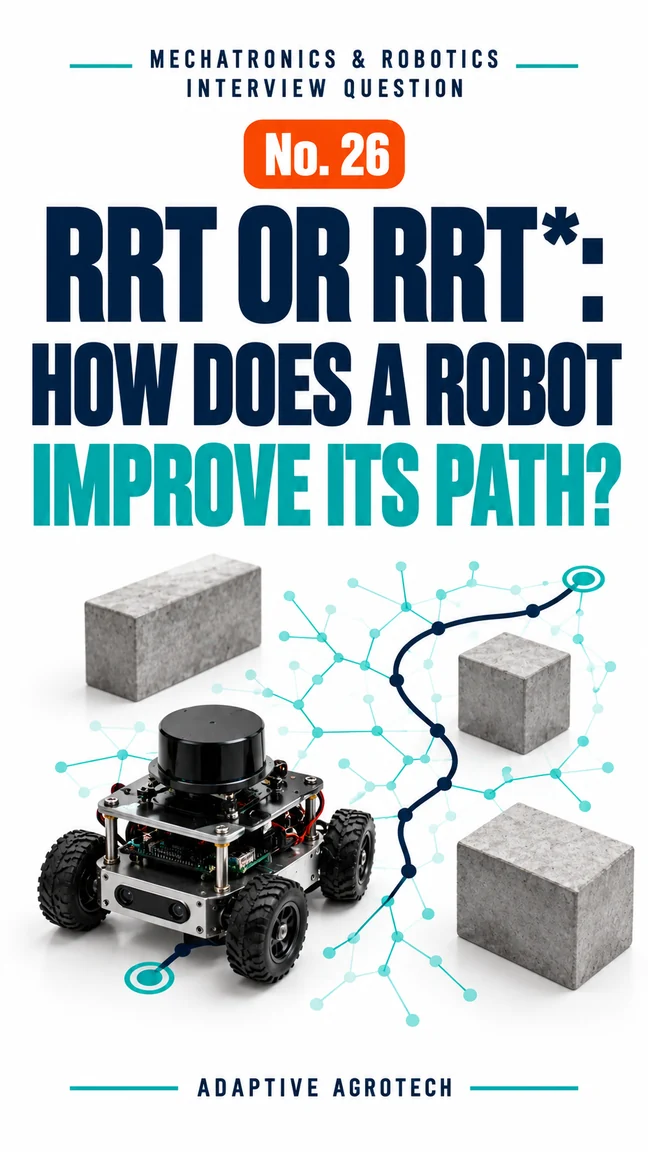
RRT vs RRT*: Finding a Path and Improving It
RRT grows a sampled configuration-space tree to find feasible paths. RRT* selects lower-cost connections and rewires the tree, improving solutions over time under assumptions without guaranteeing an optimal finite-run result.
The key idea
A dense grid can be costly in a high-dimensional configuration space. RRT instead samples configurations, finds a nearby tree node, and extends toward each sample. The entire connecting motion must be collision-free, not only its endpoint. Reaching the goal region allows parent links to recover a feasible path, though ordinary RRT does not guarantee the shortest one. RRT* compares nearby parents and rewires neighbors when a new connection lowers accumulated cost. Under suitable assumptions it approaches optimality as sampling continues. Finite computation still requires attention to route quality, motion constraints, and collision checking.
What to remember
- Check every connecting motion rather than just sample endpoints.
- Ordinary RRT finds feasibility without shortest-path guarantees.
- RRT* improves tree cost through parent selection and rewiring.
Check your understanding
Does RRT* guarantee an optimal path after any finite number of samples?
Show the explanation
No. Its optimality property is asymptotic under suitable assumptions, so a finite result can still be poor.