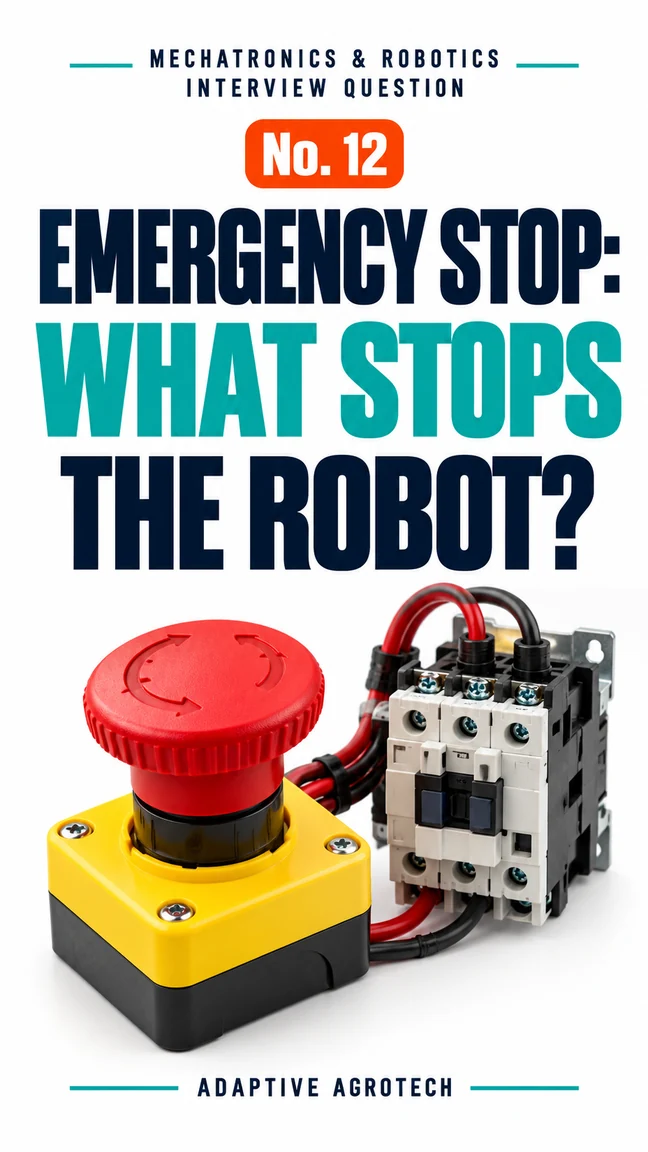
Emergency Stop: What Actually Stops the Robot?
Emergency stopping is a defined safety function across the complete stop chain. Removing torque may permit coasting, controlled deceleration may be required, and resetting the function must never automatically restart motion.
The key idea
A normal software stop uses the ordinary control path. Emergency stopping must address faults relevant to the machine's hazards through a designed safety function. Its architecture and stopping method follow risk assessment; the button alone does not establish safety. Safe torque off prevents motor-generated torque but does not instantly stop a moving robot, which may coast or move under gravity. Some applications therefore require controlled deceleration before torque removal. Mass, speed, slope, friction, and braking determine stopping behavior. After hazard removal, deliberate reset permits a restart but must require a separate intentional action to resume motion.
What to remember
- Emergency stopping depends on the complete designed stop chain.
- Torque removal does not guarantee immediate standstill.
- Reset must not automatically command motion.
Check your understanding
Does safe torque off necessarily bring a moving robot instantly to rest?
Show the explanation
No. It prevents motor-generated torque, but inertia, slope, friction, and braking determine subsequent motion.