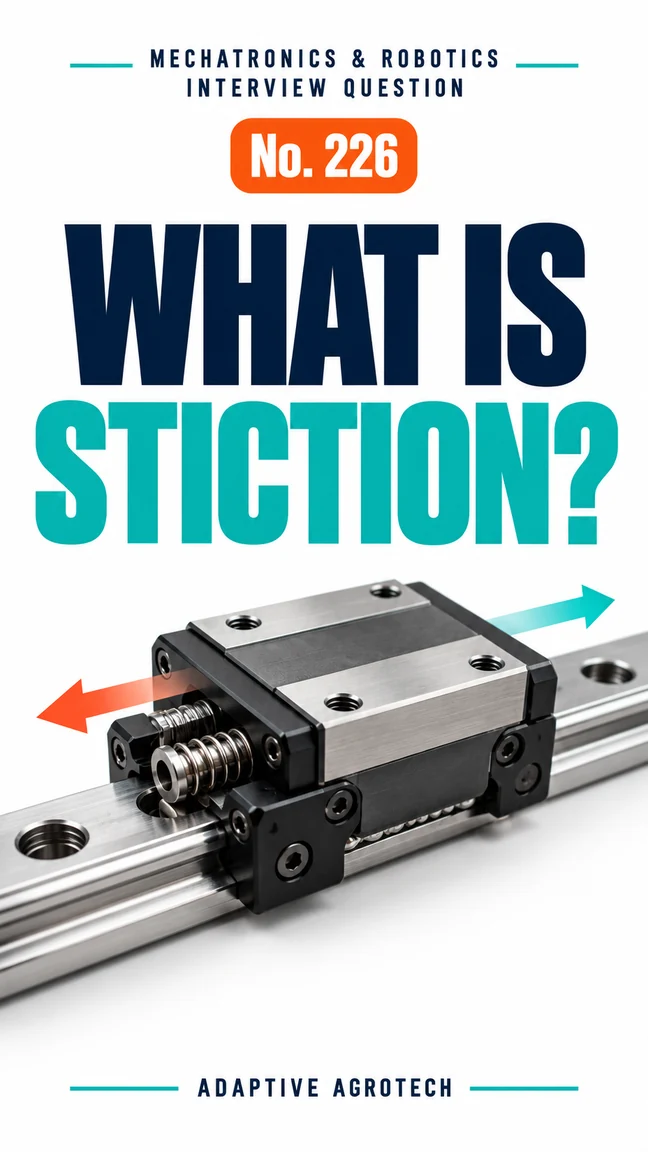
What Is Stiction, and How Does It Affect Precise Movement?
Stiction is the resistance that keeps contacting surfaces at rest until enough applied effort breaks them free. Near zero speed, static friction can exceed the friction needed to keep an axis moving.
The key idea
Stiction is the resistance that keeps contacting surfaces at rest until enough applied effort breaks them free. Near zero speed, static friction can exceed the friction needed to keep an axis moving.
Imagine a robot making a tiny alignment correction. Torque rises while the joint sticks. Once the threshold is crossed, the joint moves, and the lower sliding resistance can make it jump past the target.
This stick slip behavior can create limit cycles and poor low speed tracking. Improve mechanics and sensing before tuning compensation. Friction depends on load, lubrication, temperature, and direction, so one fixed correction may be inadequate.
What to remember
- Breakaway friction can exceed sliding friction
- A stuck axis can release into sudden motion
- Measure low speed behavior across operating conditions
Check your understanding
Why can a tiny correction command lead first to no movement and then a jump?
Show the explanation
Effort can build while static friction holds the joint. Once breakaway occurs, lower sliding resistance can cause sudden motion and overshoot, especially near zero speed.