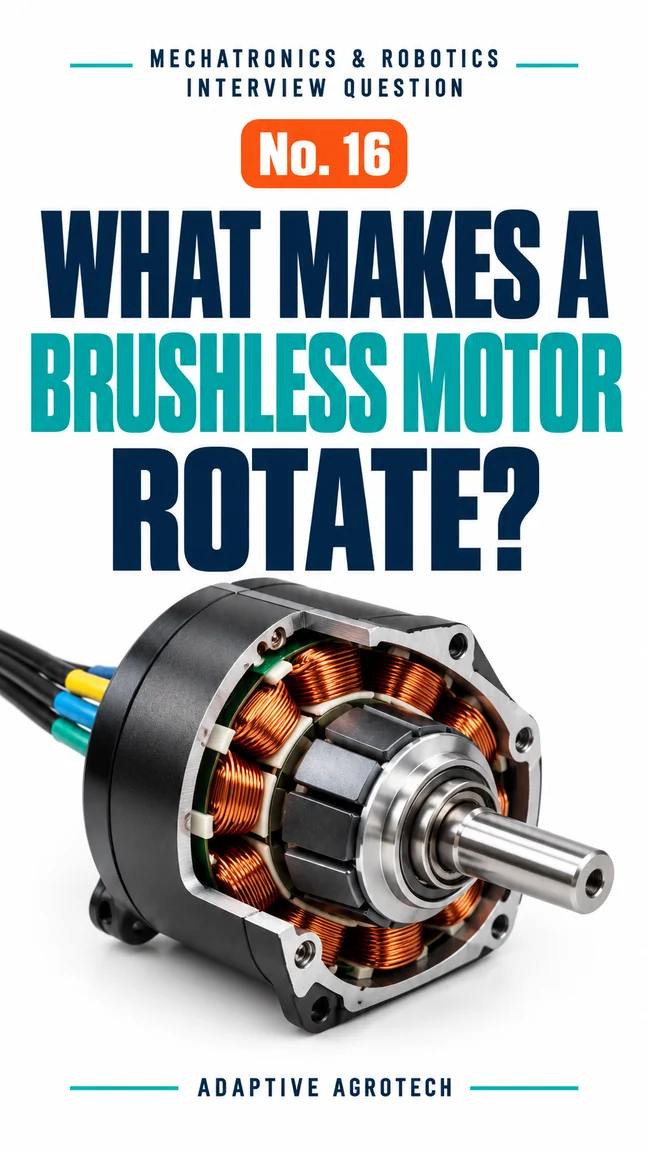
Inside a Brushless Motor: What Makes It Rotate?
Brushless motors create torque through controlled stator currents interacting with rotor magnets. Electronic commutation requires rotor information, while a separate speed-control function adjusts torque demand to track a target.
The key idea
A brushless motor has stationary stator coils and permanent rotor magnets. A compatible drive changes phase currents to create a moving magnetic field whose orientation produces sustained torque. Six-step commutation cycles through six electrical states, but an electrical cycle need not equal one mechanical revolution because the motor may have multiple pole pairs. The drive uses sensors or electrical estimates to obtain rotor-position information. Some sensorless approaches require special startup because back electromotive force is small at rest. Commutation coordinates torque generation; speed feedback separately adjusts torque demand, within compatible electronics and current limits.
What to remember
- Electronic commutation coordinates currents with rotor position.
- Pole pairs relate electrical cycles to mechanical rotation.
- Commutation and closed-loop speed regulation serve different roles.
Check your understanding
Why may a sensorless motor need a special startup strategy?
Show the explanation
Some position-estimation methods rely on back electromotive force, which is small when the rotor is at rest.