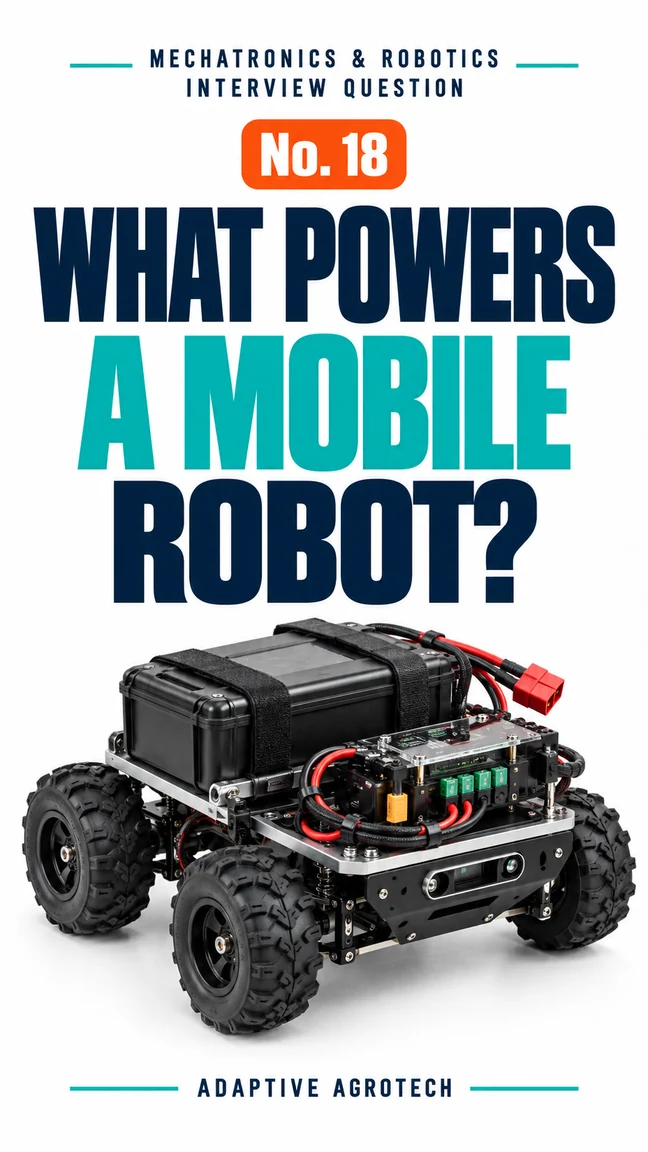
What Powers a Mobile Robot?
Reliable robot power depends on compatible voltage, usable energy, protection, and peak current. Runtime follows average demand, while motor surges and voltage drop can interrupt operation despite remaining battery capacity.
The key idea
Battery voltage must suit the robot's electronics, while usable watt-hours provide a basis for runtime estimation. Battery-management or protection settings must match chemistry and cell count. Different loads may need regulated voltage rails, and correctly rated fuses protect wiring branches against excessive current. The presentation's example of 60 usable Wh divided by a 30 W average load gives about two hours. Terrain, payload, acceleration, conversion losses, and shutdown reserve change that result. Capacity alone is insufficient: motor-current surges can pull voltage low enough to reset electronics, so peak current, voltage drop, and thermal limits also require attention.
What to remember
- Voltage compatibility and stored energy describe different requirements.
- Runtime estimates use usable energy divided by average power.
- Peak current and voltage drop can cause resets with energy remaining.
Check your understanding
What approximate runtime does 60 usable Wh provide at 30 W average demand?
Show the explanation
About two hours, before accounting for changing demand and the chosen shutdown reserve.