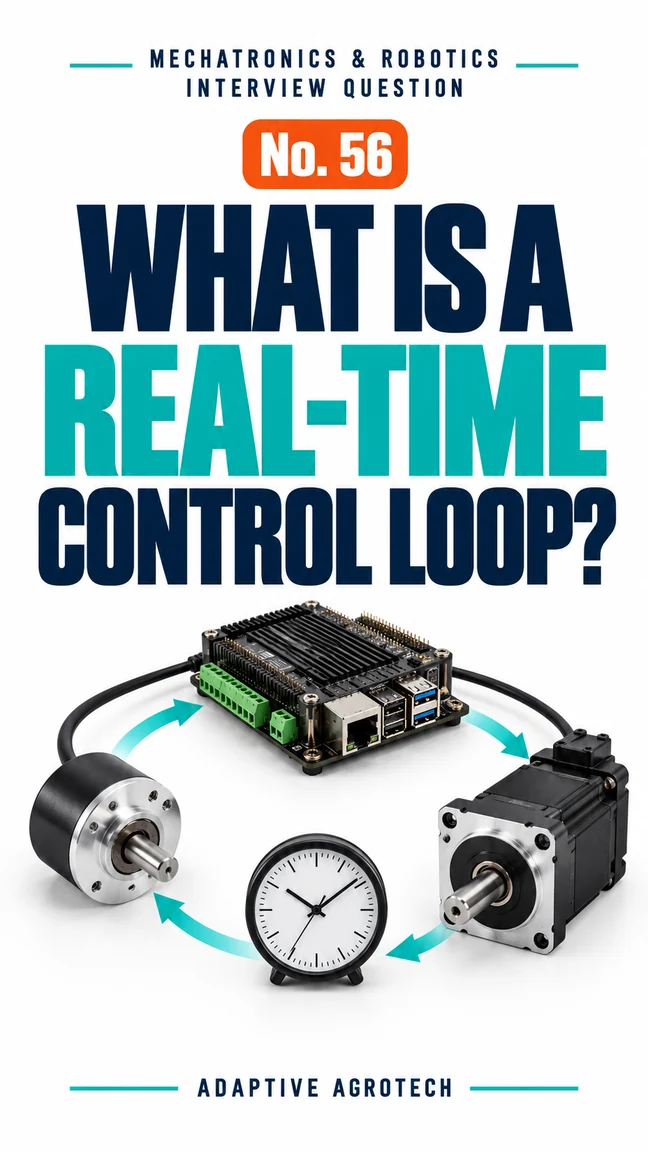
What is a Real-Time Control Loop?
Real-time control requires completion before a defined deadline rather than merely good average speed. Sensor acquisition, computation, and output share the timing budget, and worst-case delay and jitter determine whether the chain meets it.
The key idea
A real-time loop must produce and deliver its result before a defined deadline. Fast average execution does not satisfy that requirement if occasional delays leave old commands controlling the robot. In a one-millisecond example, reading sensors, computing the command, and writing outputs must all fit inside the shared budget. Jitter is timing variation, and its acceptable magnitude depends on the task. Unbounded blocking and unexpected critical-path work can break the deadline. Measurement must examine worst-case timing under load and the complete sensor-to-actuator chain, rather than timing only the central calculation or reporting an average.
What to remember
- Deadline compliance is part of real-time correctness.
- Sensing, computation, and output share one budget.
- Worst-case timing under load matters more than average speed.
Check your understanding
Why is a fast average loop time insufficient?
Show the explanation
Occasional deadline misses or excessive jitter can leave the robot acting on outdated commands.