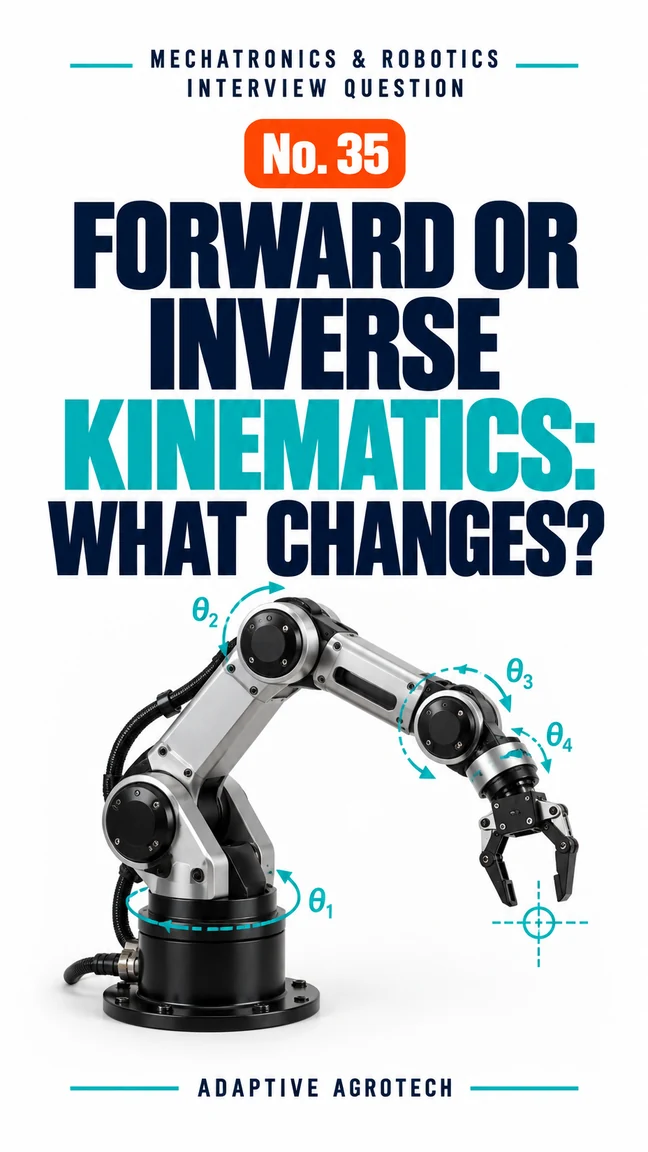
Forward vs Inverse Kinematics: Two Essential Robotics Questions
Forward kinematics maps joints to tool pose; inverse kinematics seeks joints for a target pose. Multiple solutions, unreachable targets, joint limits, and singularities distinguish kinematic feasibility from an executable collision-free motion.
The key idea
For a planar two-link arm, forward kinematics adds link contributions: the first follows its joint angle, while the second follows the sum of both angles. Known lengths and angles determine endpoint coordinates. Inverse kinematics starts from desired tool pose and finds compatible joint values. A reachable point may admit elbow-up and elbow-down configurations, while targets beyond reach have no solution. Joint limits can eliminate otherwise geometric solutions, and singular configurations restrict local motion. Even a valid inverse solution supplies joint values rather than a trajectory. Configuration selection, collision-aware planning, and joint control are still required.
What to remember
- Forward kinematics maps joint coordinates to tool pose.
- Inverse kinematics may have multiple solutions or none.
- Kinematic solutions do not themselves provide collision-free trajectories.
Check your understanding
Can a reachable endpoint have more than one inverse-kinematics solution?
Show the explanation
Yes. A two-link arm can reach some points with elbow-up and elbow-down configurations.