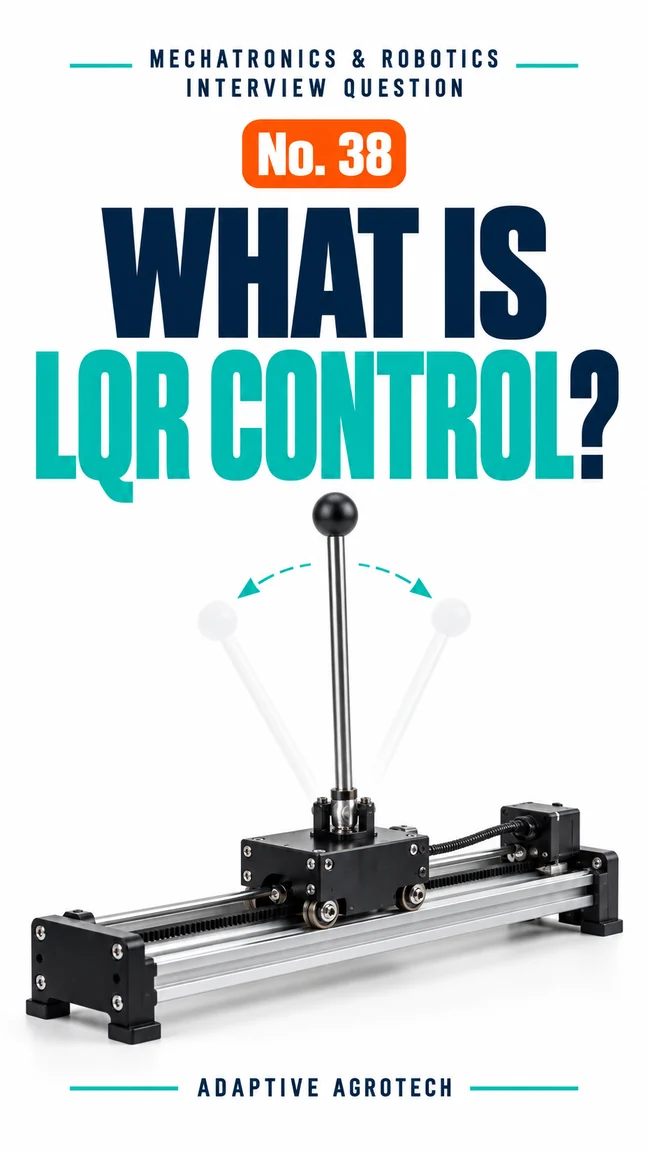
What is LQR?
LQR chooses state-feedback gains that balance state error against control effort in a linear model. Cost weights shape behavior, while the basic regulator does not impose hard actuator constraints or eliminate model error.
The key idea
A linear quadratic regulator uses a linear robot model to select a gain matrix for state feedback. Its cost balances undesirable state error against command effort. In a balancing robot, states may include tilt and tilt rate. A strong tilt penalty favors upright regulation, whereas a stronger effort penalty favors gentler commands. The resulting control law, \(u=-Kx\), converts the modeled state into a control request through the computed gain. Basic LQR does not enforce hard motor limits, so its requested command may still encounter saturation. The suitability of the linear model also remains important to achieved behavior.
What to remember
- LQR balances state error and control effort through a cost.
- The feedback gain maps state to command using u = -Kx.
- Basic LQR does not enforce hard motor limits.
Check your understanding
What changes when the effort penalty is increased?
Show the explanation
The optimization favors gentler control commands relative to reducing state error.