What is Nonlinear Adaptive Control?
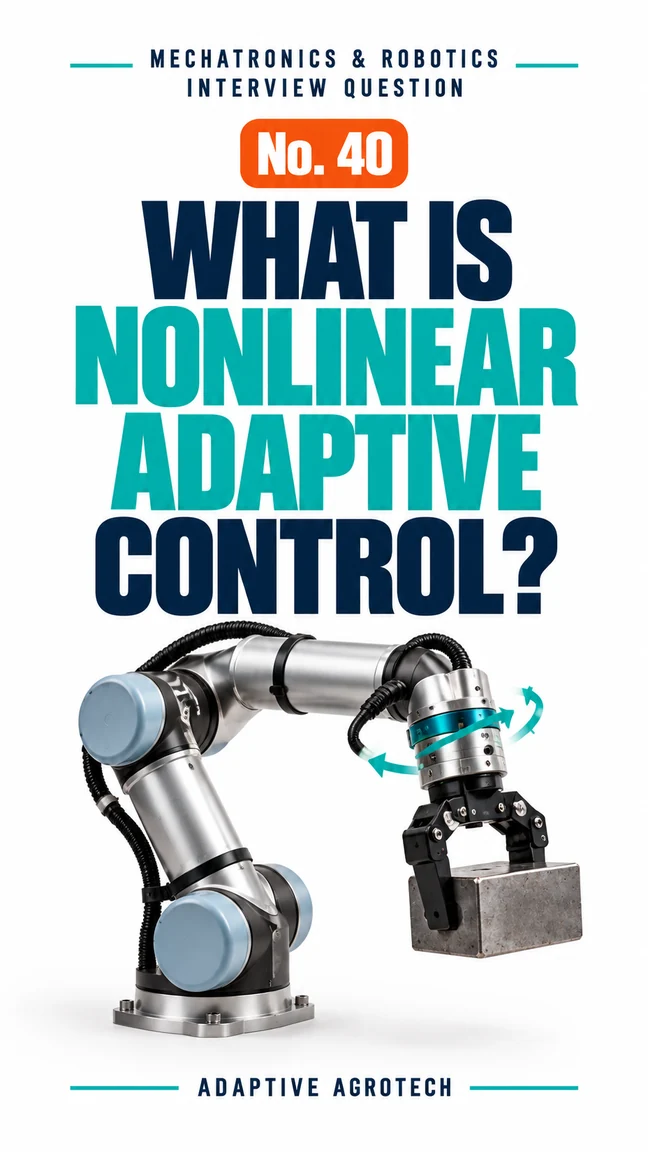
Nonlinear adaptive control combines a nonlinear law with parameter updates. Tracking error can adjust estimated payload or friction, but successful tracking does not alone establish convergence to the true physical parameters.
The key idea
A nonlinear adaptive controller includes both a nonlinear control law and an update rule for uncertain model parameters. This lets the command change when load or friction changes. For a robot arm, a new payload changes the torque required for the same motion. Tracking error can drive an update to the estimated load, which in turn changes the control request. Adaptation requires a suitable model and a proven update law; it is not justified by changing gains arbitrarily. A robot tracking well demonstrates the tracking result, but does not by itself prove every estimated parameter equals its true physical value.
What to remember
- Adaptive control updates uncertain parameters within a nonlinear design.
- Tracking error can change a load estimate and resulting torque demand.
- Tracking convergence and true parameter convergence are distinct.
Check your understanding
Does good tracking prove the estimated payload is physically exact?
Show the explanation
No. Good tracking alone does not prove convergence of each estimated parameter to its true value.