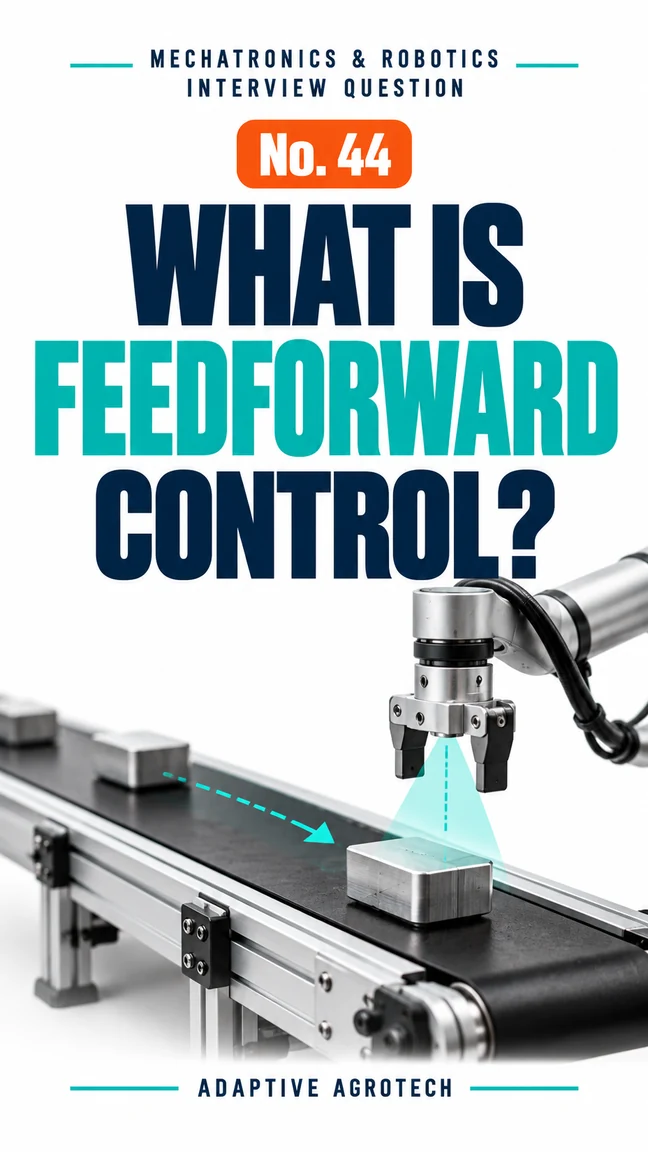
What is Feedforward Control?
Feedforward predicts required control effort from desired motion or measured disturbances. Gravity compensation and model-based wheel commands reduce feedback's workload, while model mismatch and motor limits still require feedback correction.
The key idea
Feedforward generates a command from desired motion or a measured disturbance before waiting for tracking error. A robot arm may add estimated gravity-holding torque for its load. A wheel controller may add a model-based voltage for requested speed and acceleration. These predictions provide effort that would otherwise need to arise after feedback observes an error. Their accuracy depends on the model: an incorrect load or friction estimate produces an incorrect predicted command. Combining feedforward with feedback lets the latter correct remaining mismatch. The total requested effort must still respect motor limits, even when the predictive part is calculated in advance.
What to remember
- Feedforward acts from predicted demand rather than waiting for error.
- Gravity compensation is a feedforward control example.
- Feedback corrects residual error caused by model mismatch.
Check your understanding
Why combine feedforward with feedback?
Show the explanation
The feedforward model can be wrong, and feedback corrects the resulting mismatch.