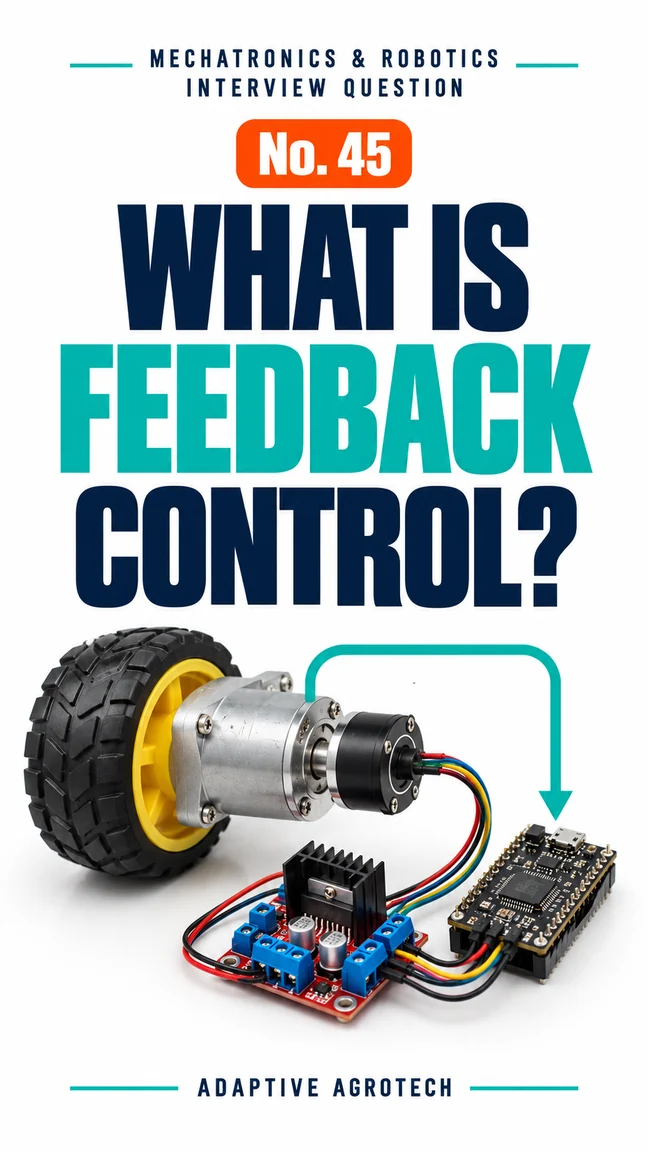
What is Feedback Control?
Feedback compares measured robot behavior with a target and changes the next command to reduce error. It can reject changing loads, while excessive gain, sensor noise, or timing delay can instead produce oscillation.
The key idea
A feedback controller measures the robot's actual response, compares it with a target, and uses the difference as an error that changes the next command. For wheel speed, an encoder supplies rotation measurements. If a slope or changing load alters motion, the controller raises or lowers motor drive to reduce the resulting discrepancy. This makes disturbance rejection possible without relying on a fixed command alone. Performance still depends on measurement quality and timing. Excessive gain, noisy sensing, or delay can turn corrective action into oscillation, so closing a loop is not by itself proof of stable target tracking.
What to remember
- Feedback updates commands using measured target error.
- Encoder speed feedback can compensate for changing wheel loads.
- Gain, sensing quality, and delay affect stability.
Check your understanding
What closes the feedback loop in the wheel-speed example?
Show the explanation
Encoder-measured rotation is compared with target speed and used to adjust the next motor command.