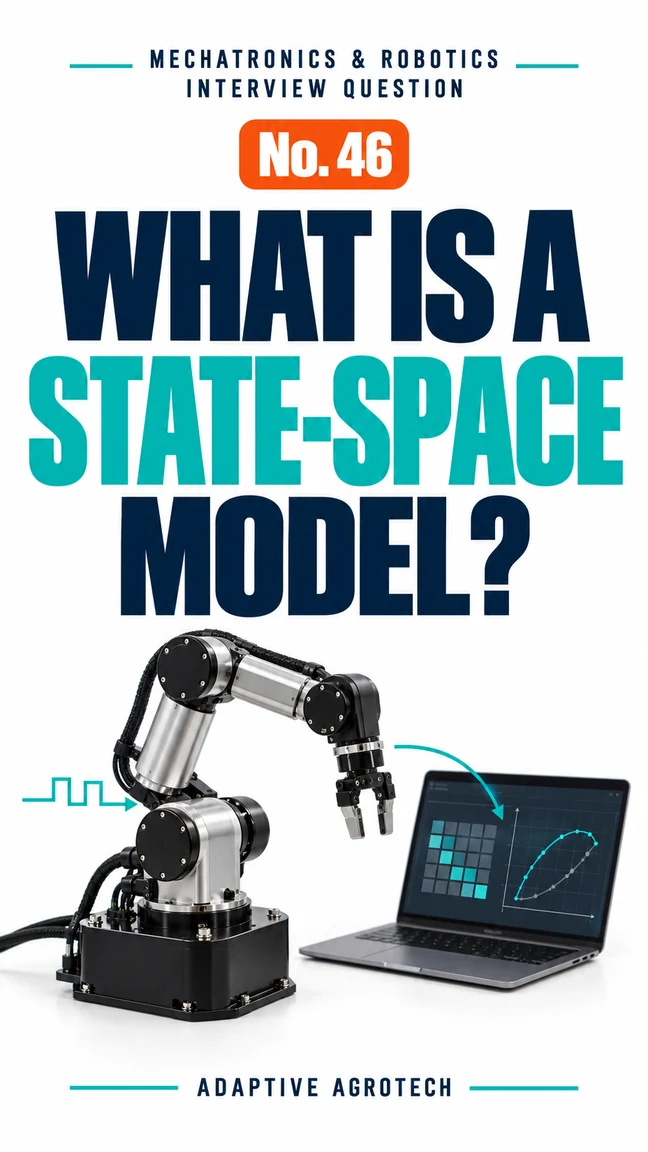
What is a State-Space Model?
A state-space model organizes internal states, inputs, and outputs to predict dynamics. Motor speed and current provide one example, while nonlinear robots may require nonlinear equations or locally valid linear approximations.
The key idea
State variables contain the dynamic information a model needs to predict future behavior. A state-space description connects these internal variables to applied inputs and measured outputs. In the motor example, speed and current form a possible state vector, voltage is the input, and encoder and current-sensor readings provide outputs for comparison. For a linear model, matrices describe how state, input, and output interact. A nonlinear robot may instead need nonlinear equations. A linear approximation can still be useful near an operating point, but its local range must be recognized when using it to predict motion.
What to remember
- The state carries the model's dynamic memory.
- Inputs affect state evolution; outputs represent measurements.
- A linear approximation may apply only near an operating point.
Check your understanding
In the motor example, which quantity acts as the model input?
Show the explanation
Applied voltage; speed and current can form the state, with sensor readings as outputs.