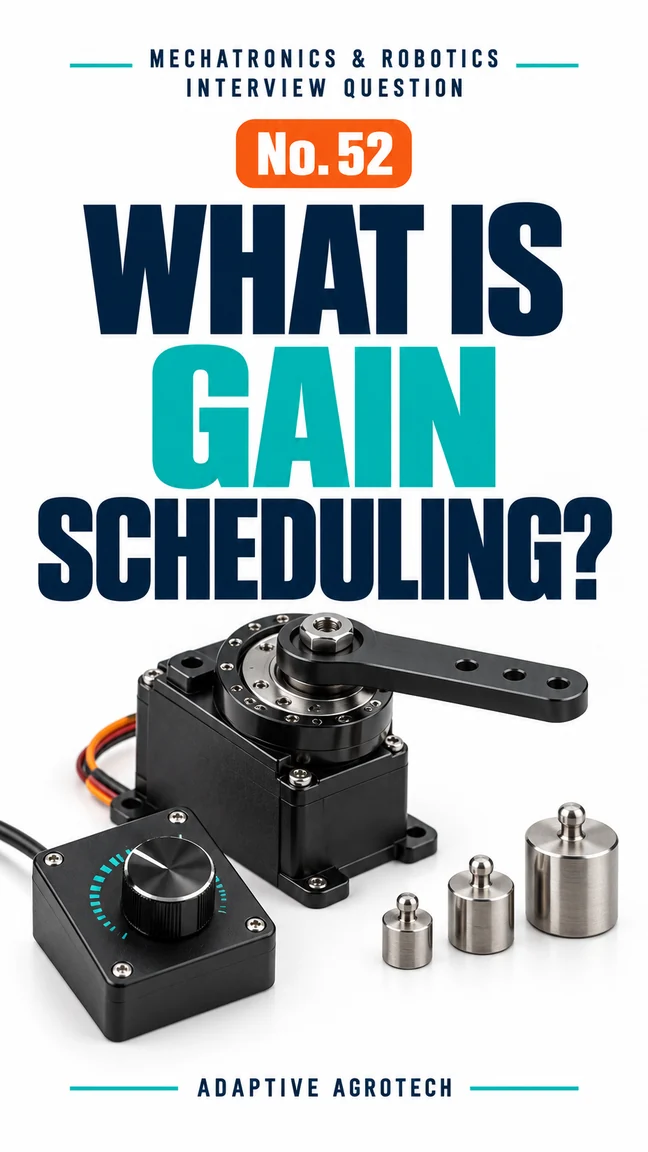
What is Gain Scheduling?
Gain scheduling selects or blends controllers using measured operating conditions. Designed gains can accommodate changing dynamics, but stable individual operating points do not by themselves establish stable transitions throughout the schedule.
The key idea
A robot's dynamics can change with speed, joint angle, or known payload, so one fixed set of gains may not suit every operating condition. Gain scheduling first designs controllers at selected points. A measured scheduling variable then selects or interpolates their gains as conditions change. Smooth blending can reduce abrupt command changes between those points. However, stability of each separately designed controller does not automatically prove stability during interpolation or transition. The full schedule and movement through it need testing, and operation should remain within the range where the design has been validated.
What to remember
- A measured operating variable selects or blends gains.
- Controllers are designed at selected operating points.
- Transition behavior requires validation beyond pointwise stability.
Check your understanding
Do stable controllers at two operating points guarantee stability between them?
Show the explanation
No. Interpolation and transitions must be evaluated across the validated operating range.