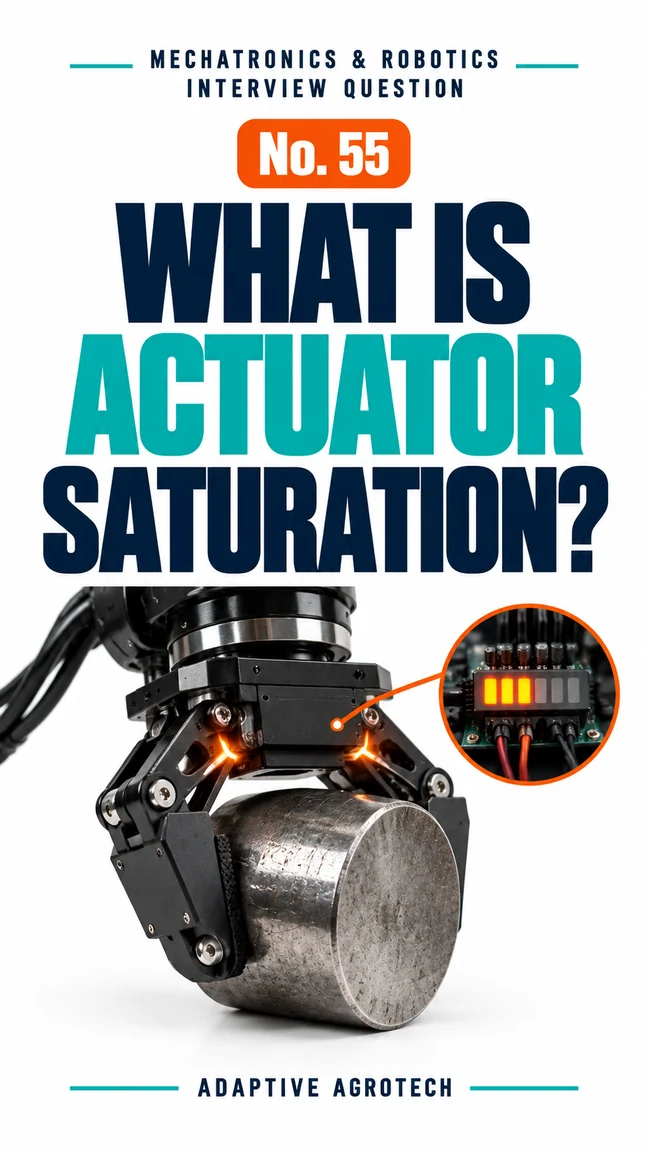
What is Actuator Saturation?
Actuator saturation clips commands at physical voltage, current, or effort limits. The delivered motion then differs from an unlimited model, potentially causing slow tracking or integral windup and requiring realistic limits in control design.
The key idea
An actuator saturates when the controller requests more than its hardware can deliver. A motor driver may reach its current or voltage limit while the command continues rising. Requesting twice the available torque does not produce twice the wheel force: delivered effort clips at the boundary. As a result, actual motion departs from a model that assumes unlimited inputs. Saturation can slow tracking, reduce stability margins, or create integral windup. Control design must include the real limits, preserve reserve effort where needed, and monitor current and temperature during operation rather than treating the requested command as guaranteed physical output.
What to remember
- Requested and delivered effort differ during saturation.
- Clipping invalidates assumptions of unlimited actuator response.
- Real limits, reserve effort, and monitoring support practical control.
Check your understanding
What happens when a controller requests torque beyond the actuator limit?
Show the explanation
Delivered torque clips at the limit rather than continuing to rise with the request.