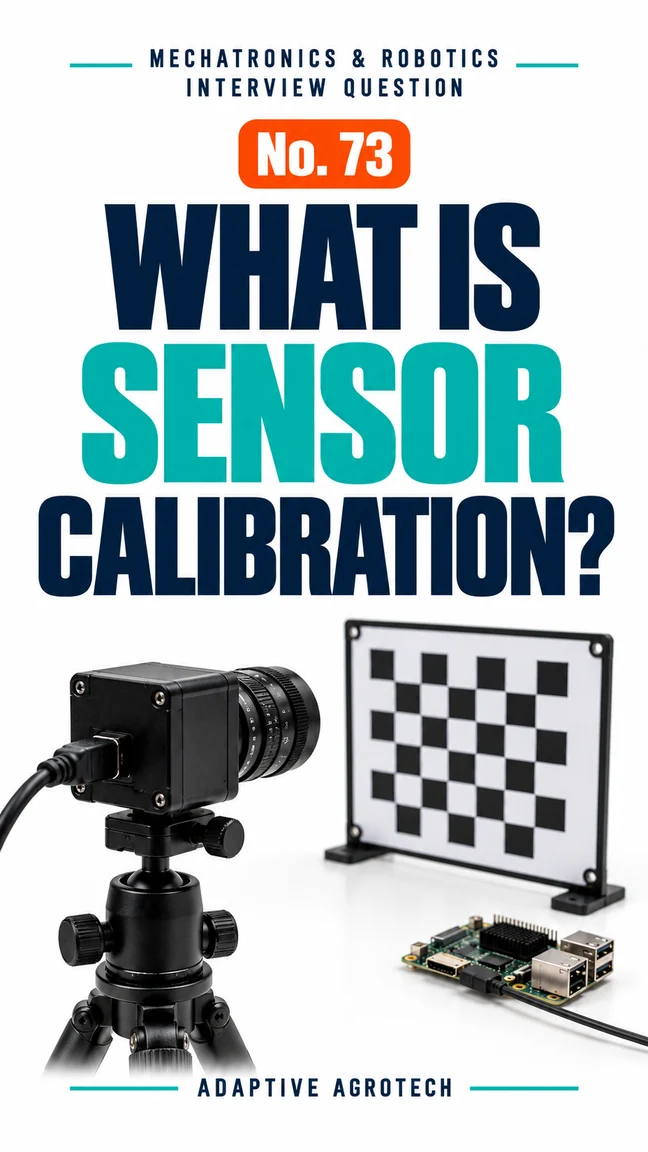
What is Sensor Calibration?
Sensor calibration estimates the parameters connecting readings to physical geometry. Known references constrain offsets, scales, distortion, and inter-sensor transforms, while independent validation and stable mounting determine whether the result remains useful.
The key idea
Calibration estimates parameters that relate sensor readings to physical quantities. Depending on the sensor, these include offset, scale, lens distortion, or relative position and orientation between devices. A camera can observe a board with known geometry to constrain unknown parameters. Shared observations can likewise help estimate the transform between camera and LiDAR frames. The fitted result must be checked with measurements excluded from the fitting process. Correct units and frame directions matter, and mechanical stability is essential: a loose bracket or altered mounting can invalidate a calibration that previously aligned the observations well.
What to remember
- Calibration estimates parameters of the measurement relationship.
- Known or shared geometry constrains unknown parameters.
- Independent checks and stable mounts maintain validity.
Check your understanding
Why can a loose sensor bracket invalidate calibration?
Show the explanation
Calibration describes a geometric relationship that changes when the sensor moves relative to its calibrated mounting.