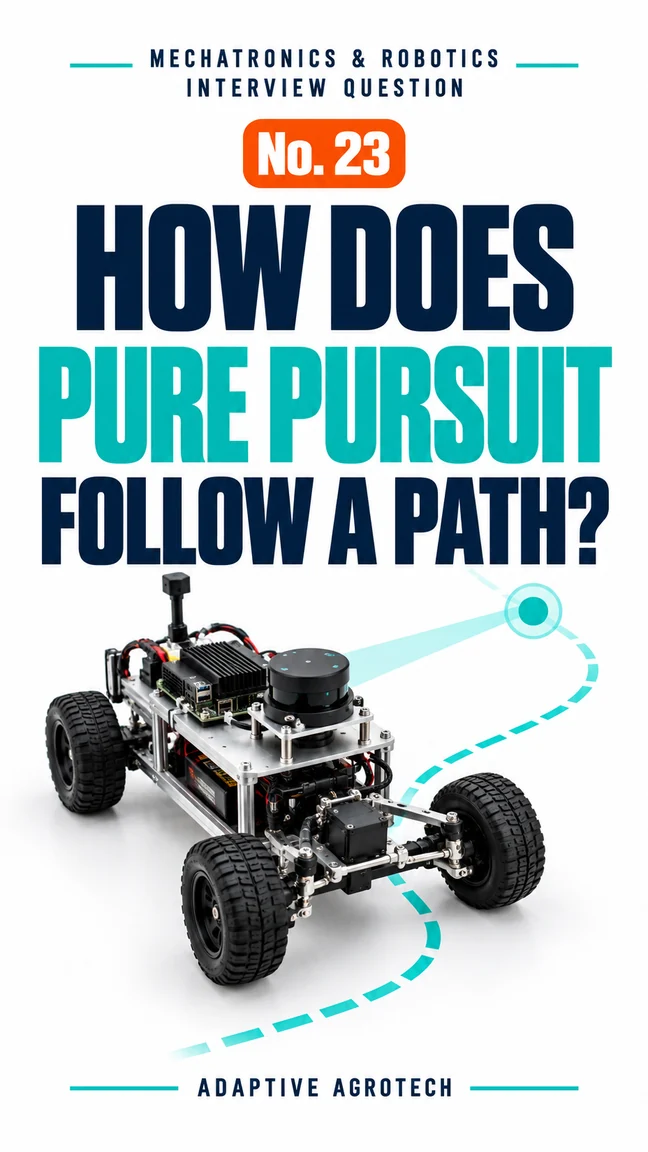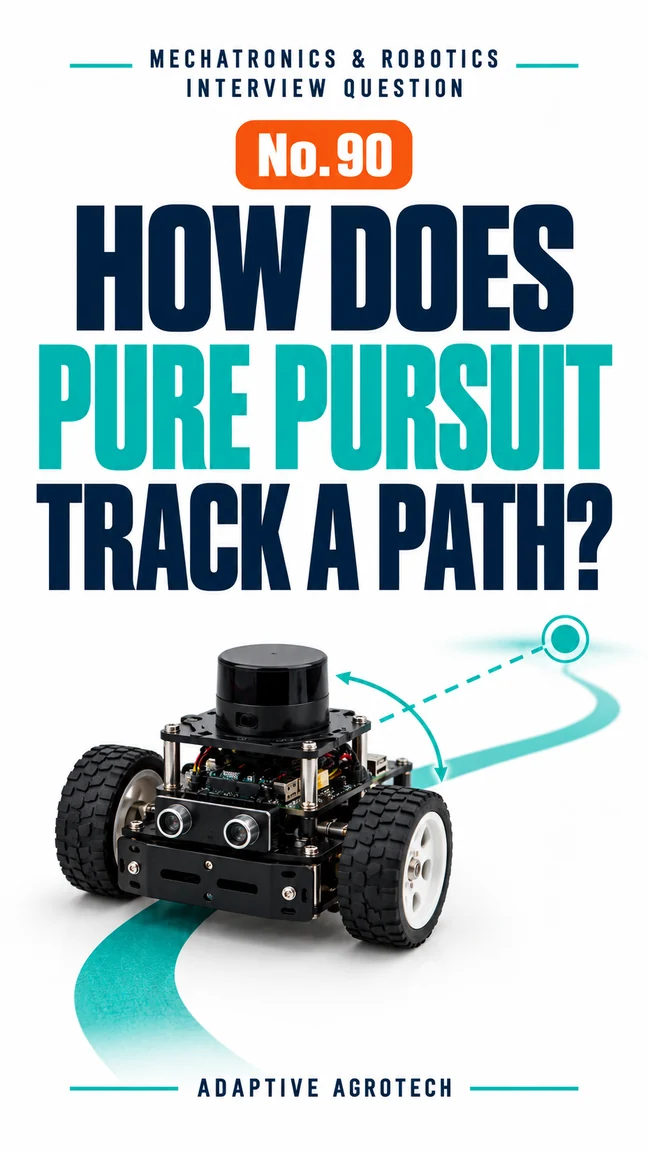
What is Pure Pursuit Path Tracking?
Pure pursuit tracks a path by steering along a tangent circular arc toward a point ahead. Look ahead distance controls responsiveness and corner cutting, while the tracker still needs separate collision checks.
The key idea
Pure pursuit selects a target point ahead on the reference path and constructs a circular arc tangent to the robot’s present heading that reaches it. The target’s lateral offset and look ahead distance determine the required curvature. At a selected forward speed, that curvature becomes a yaw rate or steering angle command. A short look ahead can respond rapidly but produce sharp turns; a longer one may cut corners. Tuning should therefore consider speed and path shape. Tracking the reference successfully does not establish that the resulting motion avoids obstacles.
What to remember
- Select a target ahead on the reference path.
- Convert tangent arc curvature into a steering or yaw command.
- Tune look ahead distance with speed and check collisions.
Check your understanding
What is a possible effect of a long look ahead distance?
Show the explanation
The robot may cut corners while pursuing the farther target.