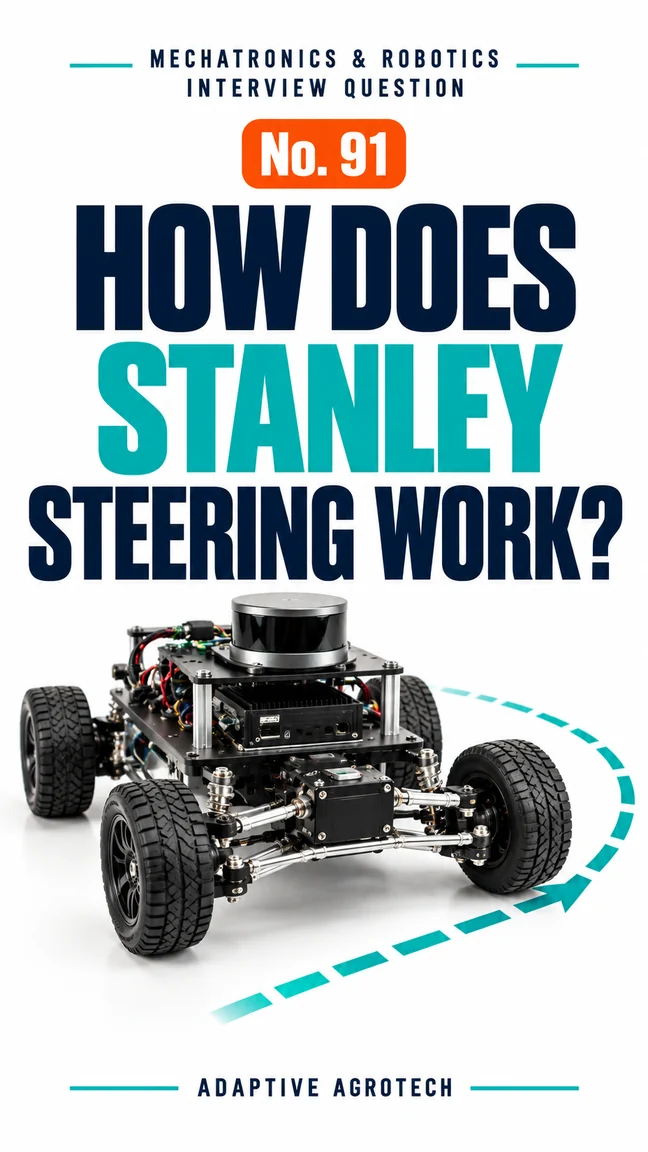
What is the Stanley Steering Controller?
The Stanley controller combines heading error with front axle cross track error to steer a car like robot. Speed scales the lateral correction, and practical implementations must handle low speed behavior and steering limitations.
The key idea
The Stanley steering controller measures the difference between vehicle and path heading together with lateral distance from the path at the front axle. Its basic command adds a heading correction to an angle determined by cross track error and speed. The same lateral error produces a smaller cross track contribution at higher speed. This can support tasks such as guiding a farm vehicle along a crop row. Near zero speed, the basic formula needs careful handling, and real vehicle control also needs to account for steering limits, actuator delay, and tire slip.
What to remember
- Measure cross track error at the front axle.
- Combine heading and speed scaled lateral corrections.
- Handle low speed behavior and physical steering limits.
Check your understanding
How does higher speed affect the cross track term for the same sideways error?
Show the explanation
It makes the basic cross track correction term smaller.