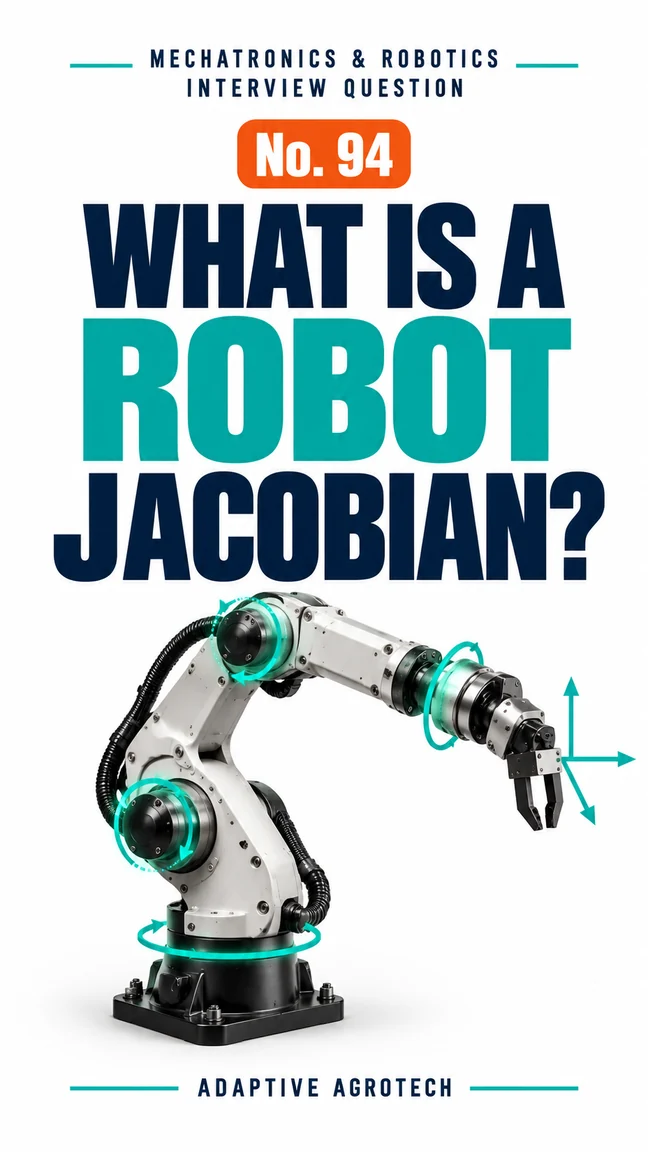
What is a Robot Jacobian?
The robot Jacobian maps joint rates to instantaneous tool velocity at a particular configuration. Its columns describe individual joint contributions, making it useful for local motion and force calculations rather than complete path planning.
The key idea
A robot Jacobian is a configuration dependent map from joint speeds to the tool’s instantaneous velocity. In the relation tool velocity = J × joint rates, each column describes the contribution of one joint. For a two joint arm, adding the two joint contributions gives the total current tool motion. Because the matrix changes with joint angles, identical motor speeds can produce different tool velocities at different poses. Controllers use this local relationship for motion and force calculations. Near a singular configuration, some desired velocities may require very large joint rates.
What to remember
- Map joint rates to current tool velocity.
- Each column represents one joint’s contribution.
- The mapping changes with configuration and can become ill conditioned.
Check your understanding
Why can identical joint speeds give different tool motion at different poses?
Show the explanation
The Jacobian depends on the robot’s joint configuration.