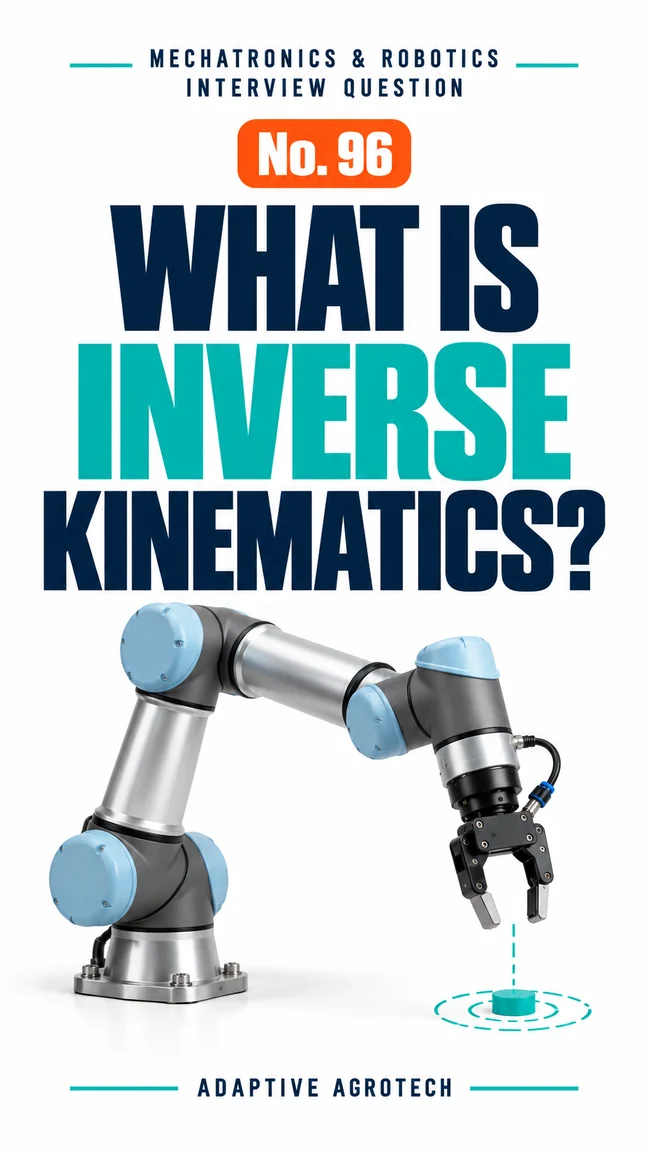
What is Inverse Kinematics?
Inverse kinematics finds joint values for a desired tool pose. A target can have several solutions or none, so solution choice must respect joint limits and the complete arm motion must be checked.
The key idea
Forward kinematics predicts a tool pose from known joint values; inverse kinematics works backward from the desired tool pose to candidate joints. A two link arm may reach one point with either an elbow above or an elbow below the target line, illustrating multiple solution branches. A target outside the workspace has no solution. Among available candidates, the chosen solution should satisfy joint limits and suit the arm’s current configuration. Even a valid endpoint does not establish a clear route to it, so collision checks must cover the complete arm motion.
What to remember
- Solve backward from tool pose to joint values.
- Targets may have multiple solutions or no solution.
- Check joint limits and the complete movement path.
Check your understanding
Does a valid inverse kinematics endpoint prove the movement to it is collision free?
Show the explanation
No. The full arm motion must also be checked.