What is a Quadrature Encoder?
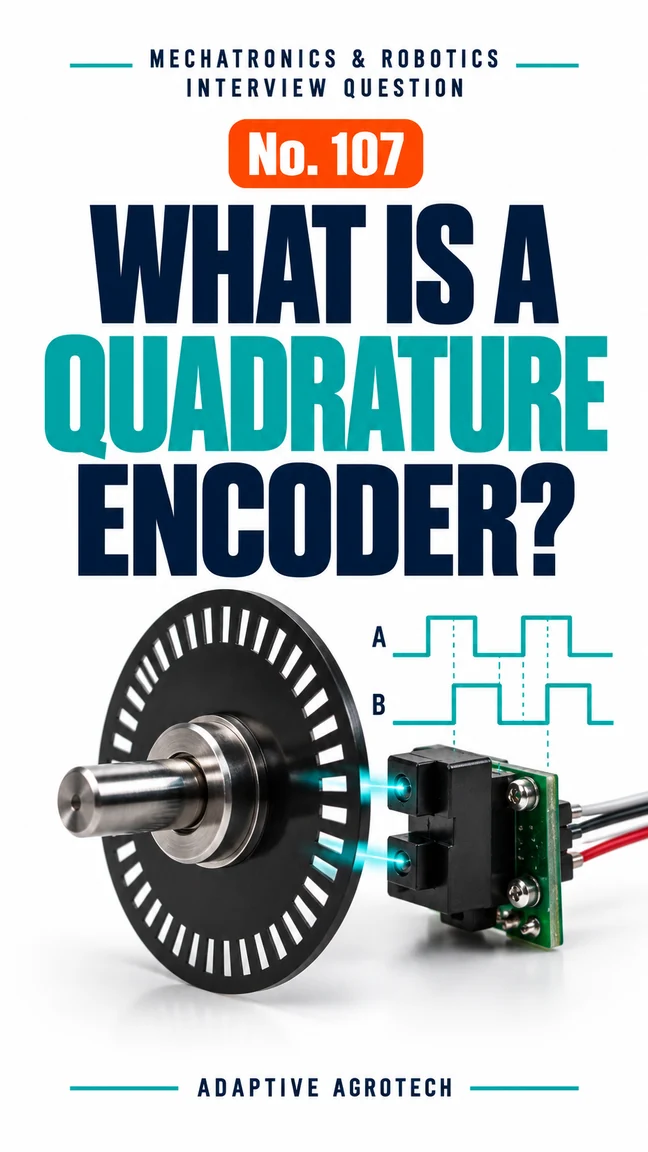
A quadrature encoder supplies two signals separated by a quarter cycle, revealing rotation direction and rate. Four-edge decoding improves count resolution, but converting counts into robot travel still depends on mechanics and wheel slip.
The key idea
Quadrature encoders produce channels A and B shifted by ninety degrees of their signal cycle. Which channel leads reveals direction: the leading order reverses when shaft rotation reverses. Edge rate measures rotational speed, and counting both edges on both channels gives four counts per complete signal cycle. To estimate a robot’s travel, those counts must be converted using the gear ratio and wheel dimensions. This calculation measures encoder related motion rather than guaranteed ground movement. Missed edges and wheel slip can still introduce errors, even when the nominal count resolution is fine.
What to remember
- Phase order reveals rotation direction.
- Both edges of both channels yield four counts per cycle.
- Wheel travel estimates depend on gearing, wheel size, and slip.
Check your understanding
How many counts per cycle does four-edge quadrature decoding provide?
Show the explanation
Four counts per signal cycle.