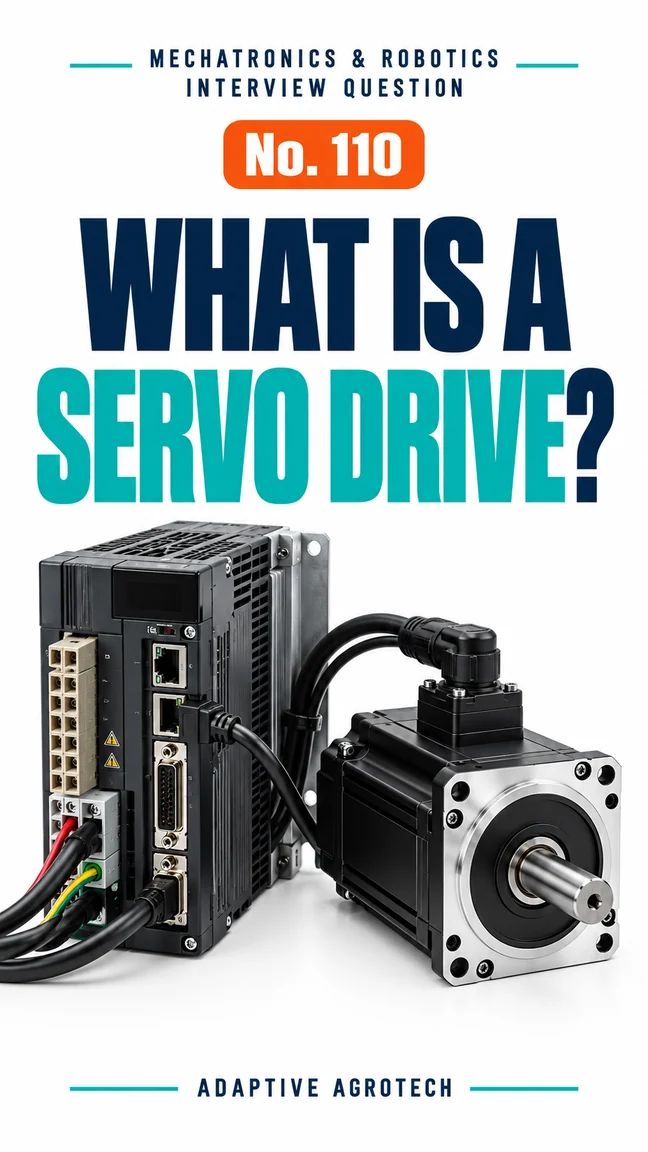
What is a Servo Drive?
A servo drive controls motor power using feedback to follow a motion or torque command. Common nested current, speed, and position loops must be tuned around the real mechanics and operating limits.
The key idea
A servo drive turns a motion or torque request into controlled motor power and uses feedback to help the motor follow that request under load. A common arrangement nests a fast current loop inside slower speed and position loops, with each outer loop commanding the next inner one. An encoder supplies motion information. In a robot joint, this structure can hold a position or track a changing target. Its performance still depends on the actual mechanism, so tuning must consider the load, resonance, current limits, and the possibility of faulty sensor information.
What to remember
- Feedback helps the motor follow a requested motion.
- Current control commonly sits inside speed and position control.
- Tune with the real load, resonance, and current limits.
Check your understanding
Which loop is commonly innermost in a servo drive?
Show the explanation
The fast current control loop.