What is Aliasing?
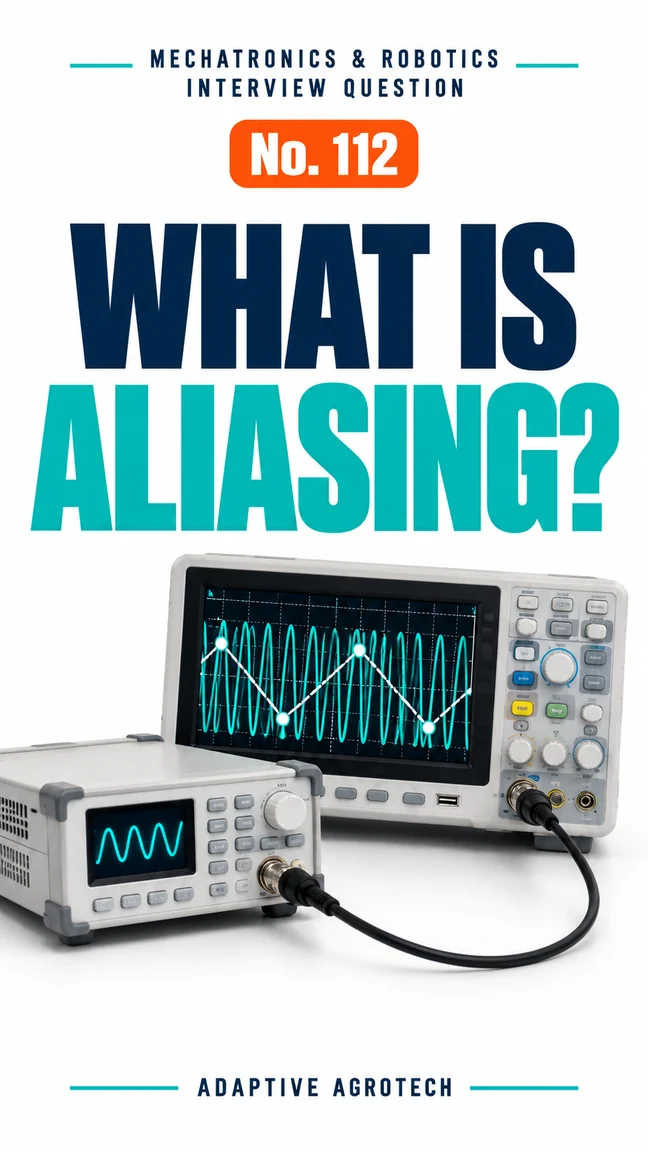
Aliasing makes distinct input frequencies indistinguishable after sampling, potentially turning fast vibration into an apparent slow signal. Analog bandwidth limiting and a sufficient sample rate must prevent the ambiguity before conversion.
The key idea
Aliasing occurs when different continuous input frequencies produce indistinguishable sampled values. A robot controller may then react to an apparent vibration that does not represent the original motion. For example, a seventy hertz signal sampled at one hundred samples per second appears as thirty hertz in the sampled data. The remedy is to limit analog bandwidth before conversion and sample above twice the highest frequency retained, with practical margin for the filter. Once frequencies have folded together during sampling, a digital filter applied afterward cannot reconstruct which original input produced them.
What to remember
- Different frequencies can produce the same sample sequence.
- A 70 Hz signal at 100 samples/s aliases to 30 Hz.
- Use analog filtering and an adequate sampling rate before conversion.
Check your understanding
Can filtering after sampling undo aliasing?
Show the explanation
No. Frequencies that have become indistinguishable cannot be separated by later filtering alone.