What is a Low-Pass Filter?
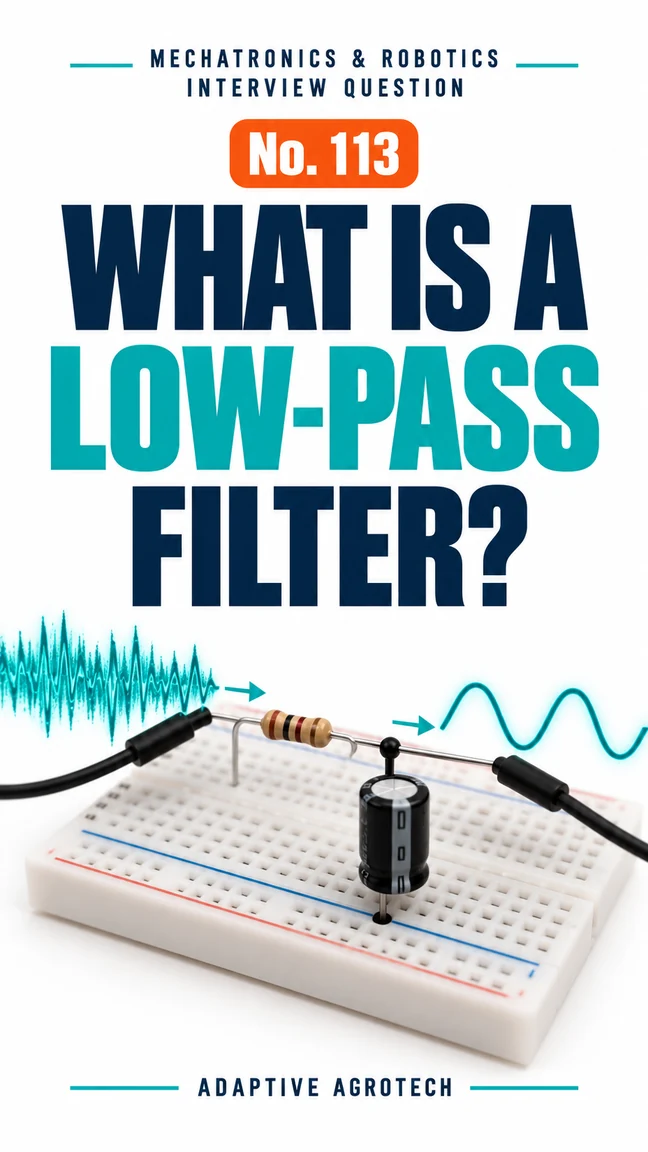
A low-pass filter attenuates rapid changes while preserving slower signals, which can smooth robot measurements. Its cutoff sets a bandwidth tradeoff, and the resulting delay can conceal events the controller needs.
The key idea
A low-pass filter reduces high frequency components while passing slower variations. This can smooth a noisy robot sensor, but it also changes timing by delaying useful information. For a simple resistor capacitor filter, cutoff is given by 1 / (2πRC), where the output amplitude is about 0.707 of the input amplitude. Choose a cutoff that retains the motion or events relevant to the task rather than only making the plot look smooth. When preventing aliasing, the appropriate filter must act on the analog signal before sampling occurs.
What to remember
- Attenuate fast changes while retaining needed slower motion.
- An RC cutoff is 1 / (2πRC).
- Smoothing introduces delay and can hide fast events.
Check your understanding
What is the amplitude ratio at a simple RC filter’s cutoff?
Show the explanation
Approximately 0.707 of the input amplitude.