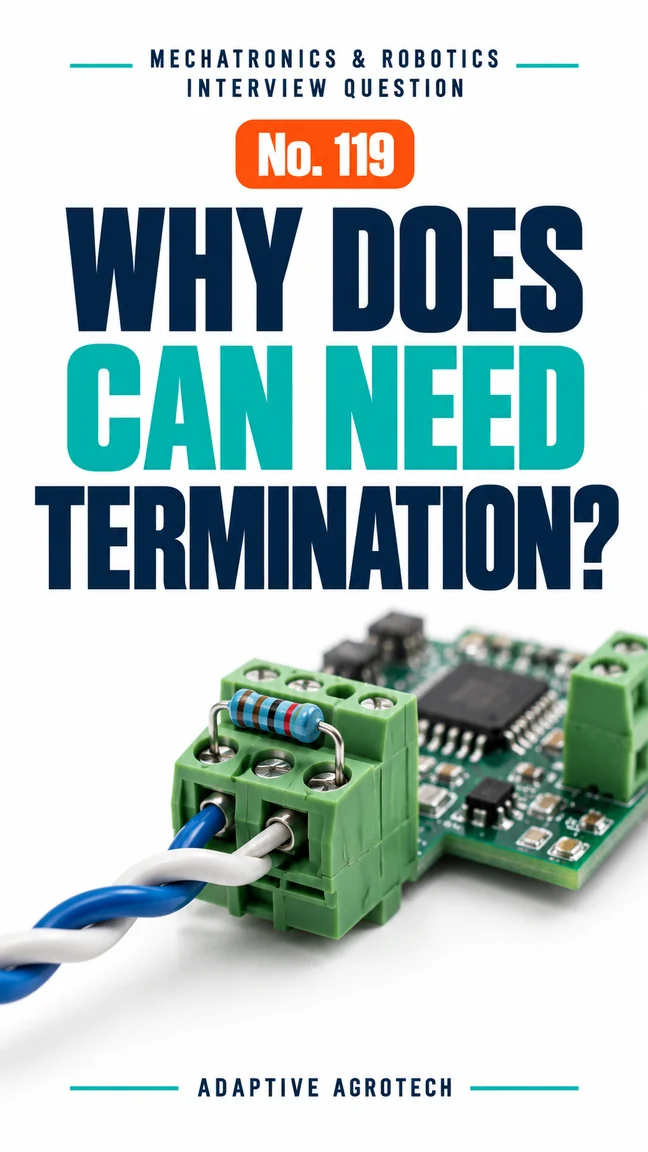
What is a CAN Bus Termination Resistor?
CAN termination reduces signal reflections at the cable ends. A typical high speed bus uses two 120-ohm resistors, whose parallel resistance is about 60 ohms when measured across the unpowered pair.
The key idea
Electrical signal edges can reflect at an unterminated cable end and disturb CAN reception. A typical high speed CAN installation places a 120-ohm resistor across CAN high and CAN low at each physical end of the main cable. With the bus powered off, the two termination resistors appear in parallel, so measuring across the pair often gives approximately 60 ohms. This is a useful wiring check within that expected topology. Adding terminators at extra locations increases the load on the network drivers rather than improving the intended two-end termination arrangement.
What to remember
- Terminate the two physical ends of the main cable.
- Typical high speed CAN uses 120 Ω at each end.
- Two 120 Ω resistors in parallel measure about 60 Ω.
Check your understanding
Why does an unpowered correctly terminated typical bus measure about 60 Ω?
Show the explanation
The two 120-ohm end resistors are connected in parallel.