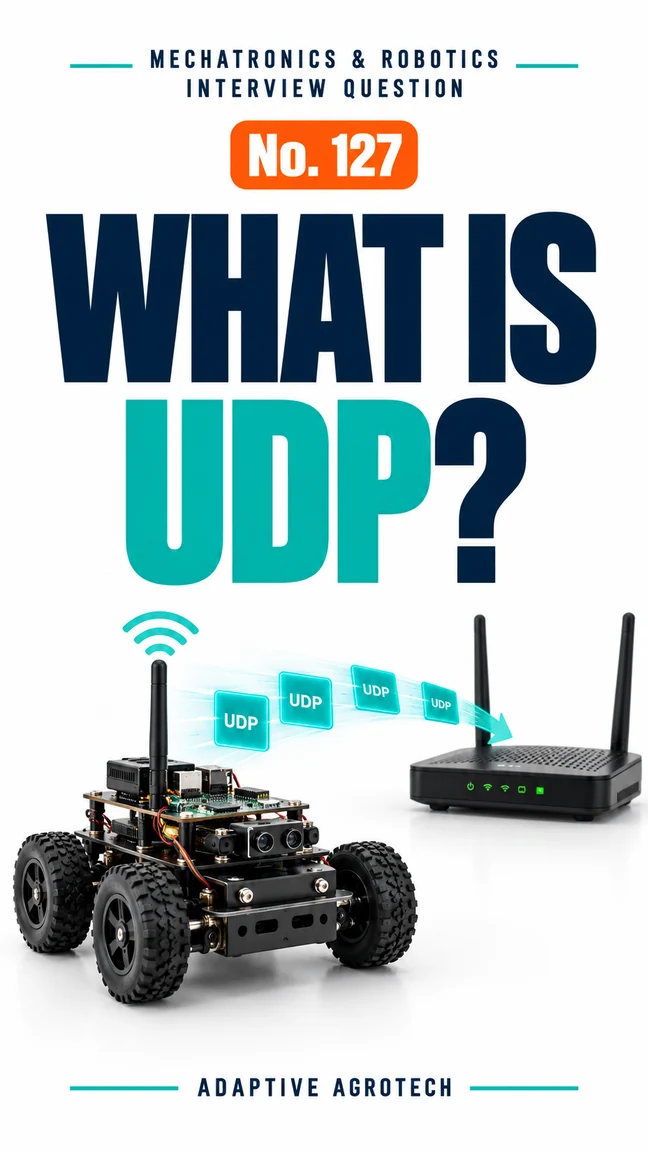
What is UDP?
UDP transports separate datagrams with low transport overhead but no built-in guarantee of arrival or order. Robot streams should track sequence and measurement age, since choosing UDP alone does not establish timely or safe control.
The key idea
UDP sends datagrams between network ports while preserving each message boundary. Its relatively small transport overhead can suit frequent robot sensor updates, but UDP itself does not guarantee delivery, ordering, or duplicate protection. A receiver might obtain samples one, three, and four while sample two is lost. Applications can add sequence numbers and timestamps to recognize missing, reordered, or stale measurements and decide what to discard. These measures support use of fresh information, but the protocol choice alone does not guarantee low delay or that a robot control deadline will be met.
What to remember
- UDP preserves datagram boundaries.
- Loss, reordering, and duplicates require application handling.
- Track sequence numbers and measurement timestamps.
Check your understanding
Why should a robot UDP stream include timestamps?
Show the explanation
They let the receiver assess measurement age and reject stale samples.