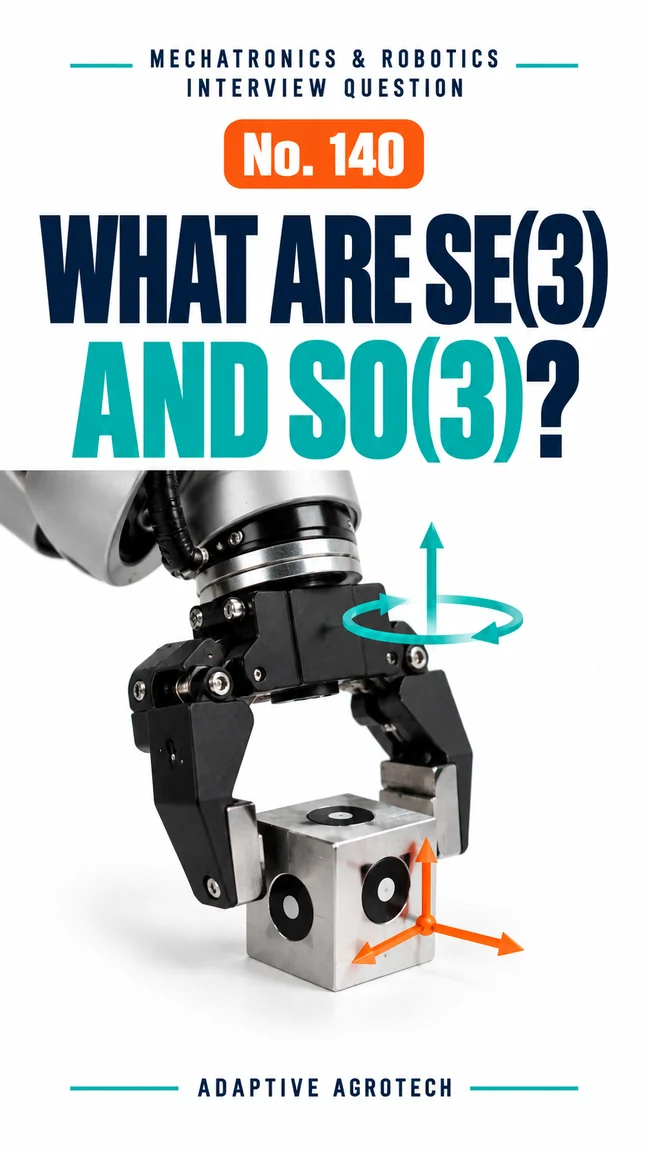
What Are SE(3) and SO(3) in Robotics?
SO(3) contains valid three dimensional rotations, while SE(3) contains rigid poses with rotation and translation. Their stored matrices obey constraints, excluding scaling, shear, and reflections despite containing more entries than independent degrees of freedom.
The key idea
SO(3) is the set of three by three rotation matrices with orthonormal columns and determinant positive one. It represents orientation with three independent degrees of freedom. SE(3) combines such a rotation and a translation in a homogeneous matrix, representing a rigid pose with six degrees of freedom. A camera turning in place changes orientation; translating it as well changes its full pose. Both sets support composition and inversion. Their matrix entries are constrained, so arbitrary arrays are not valid members, and scaling, shearing, or reflection does not describe an SO(3) rotation.
What to remember
- SO(3) represents orientation with three degrees of freedom.
- SE(3) represents rigid pose with six degrees of freedom.
- Valid rigid transforms preserve lengths and handedness.
Check your understanding
What does SE(3) add beyond the orientation represented by SO(3)?
Show the explanation
Translation, giving a complete rigid pose with six degrees of freedom.