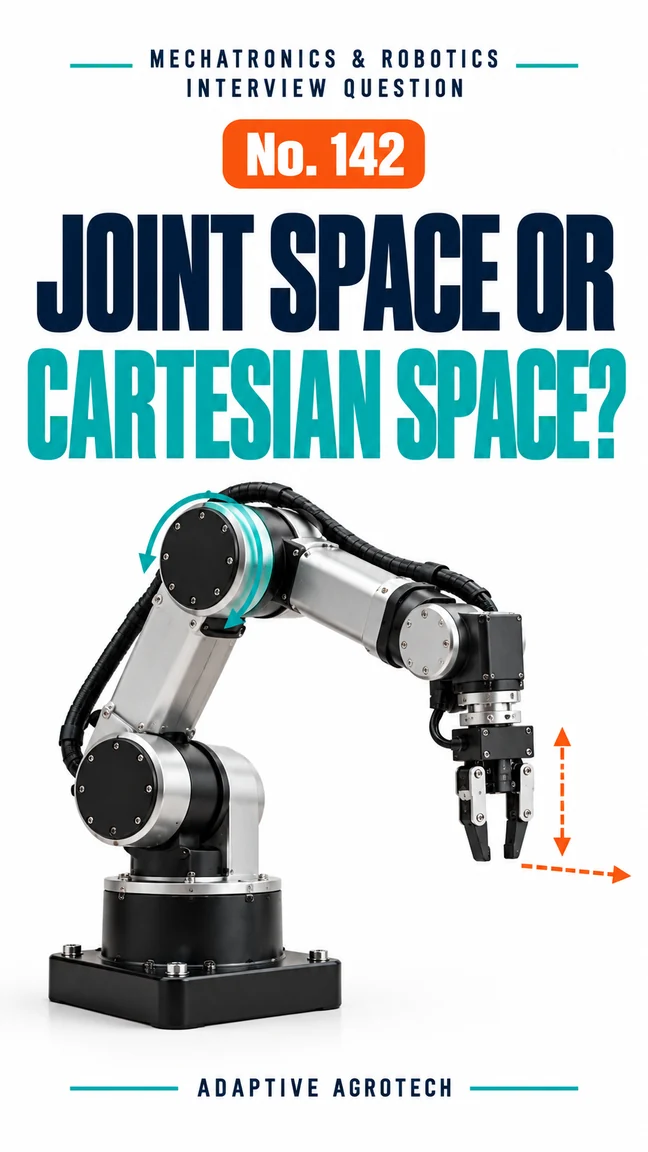
What Is the Difference Between Joint Space and Cartesian Space?
Joint space describes the robot through joint coordinates, while Cartesian space describes tool pose relative to a frame. Their paths differ geometrically, so a straight interpolation in one space need not be straight in the other.
The key idea
Joint space uses coordinates such as shoulder and elbow angles, whereas Cartesian space expresses tool position and orientation in a chosen frame. Forward kinematics relates the joint configuration to the tool pose. For a two link planar arm, smoothly interpolating its two angles generally makes the tool trace a curved workspace path. A straight Cartesian tool path instead requires finding suitable joint motion along that line. Neither description removes physical constraints: requested poses may be unreachable, and joint limits, singularities, and obstacles still restrict a valid motion regardless of the space used to specify it.
What to remember
- Joint space uses joint coordinates; Cartesian space uses tool pose.
- Straight joint interpolation generally yields a curved tool path.
- Both descriptions must respect limits, singularities, and obstacles.
Check your understanding
Is a straight line in joint space generally a straight tool path?
Show the explanation
No. Forward kinematics usually maps it to a curved Cartesian path.