What Is Differential Inverse Kinematics?
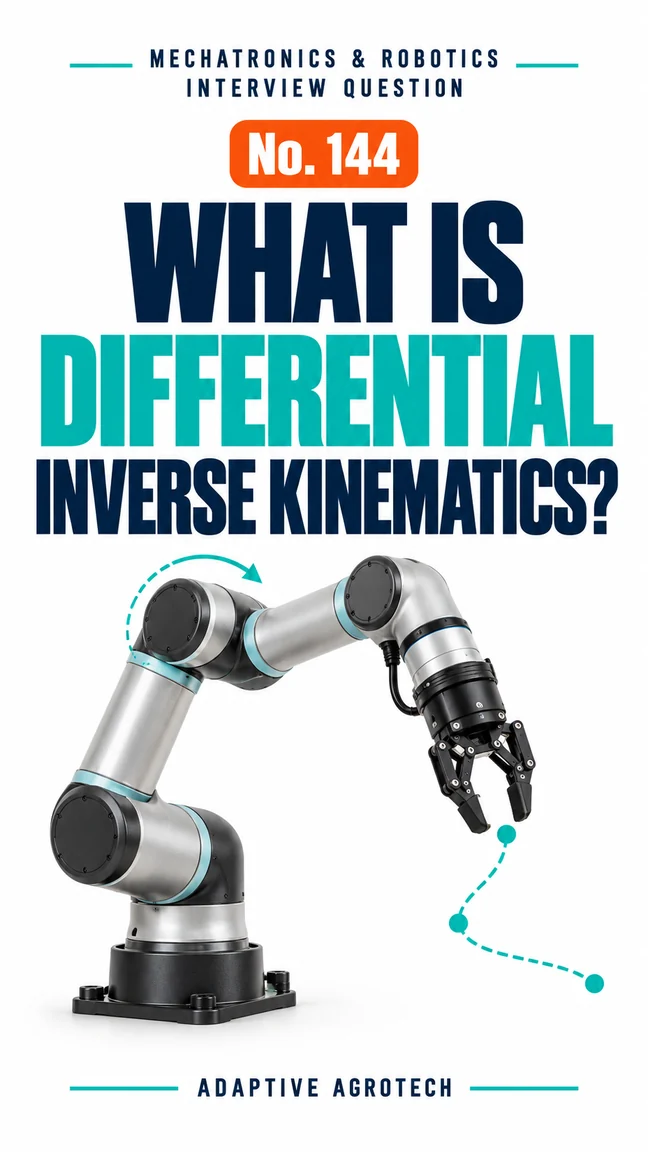
Differential inverse kinematics solves locally for joint speeds that produce a desired tool velocity. The Jacobian must update as motion progresses, and damping near singularities trades tracking accuracy for less extreme joint commands.
The key idea
Differential inverse kinematics uses the current Jacobian in xdot = J(q) qdot to convert a desired tool velocity into joint rates. A pseudoinverse supplies a useful solution when appropriate. For a planar arm asked to move its tool slowly rightward, the controller computes shoulder and elbow speeds, integrates briefly, and updates the Jacobian at the new configuration. Near singularities, small requested tool velocities can demand large joint rates. Damped least squares reduces that amplification at the cost of tracking error. Joint and velocity limits still need enforcement, and some requested directions can be locally infeasible.
What to remember
- Solve the current local velocity relation using the Jacobian.
- Recompute as configuration changes.
- Damping reduces amplification while introducing tracking error.
Check your understanding
What is the tradeoff introduced by damped least squares?
Show the explanation
It reduces excessive joint speed amplification but introduces tool velocity tracking error.