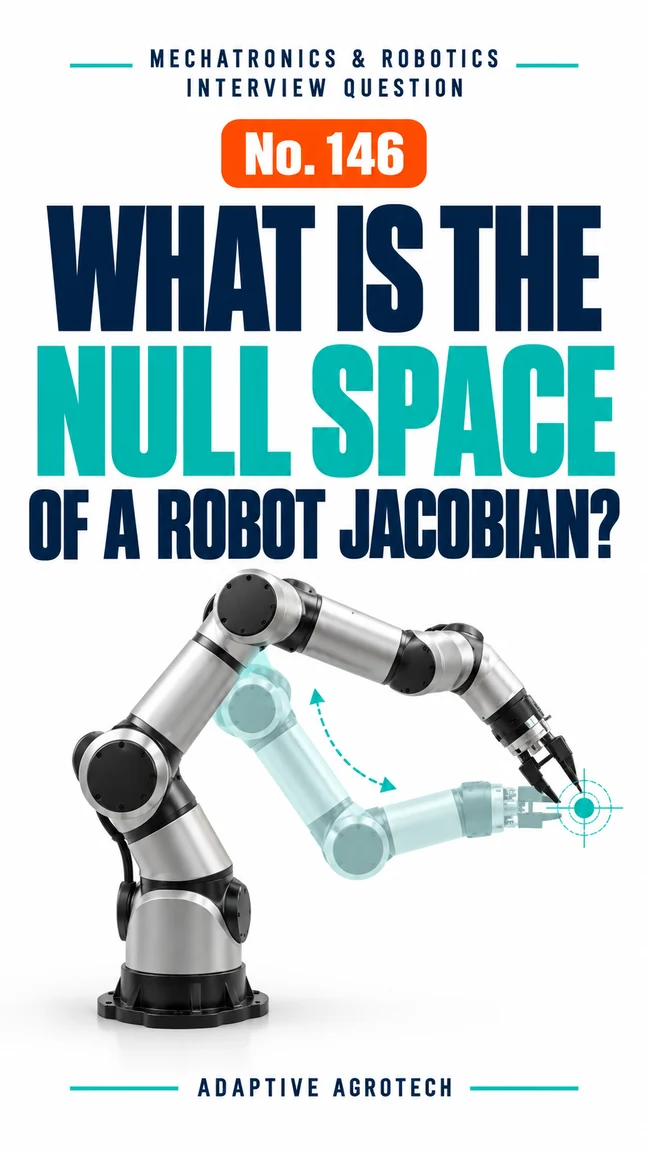
What Is the Null Space of a Robot Jacobian?
A task Jacobian’s null space contains joint motions that leave the selected task instantaneously unchanged. Redundant motion can adjust posture, but the preserved task, current configuration, and repeated updates determine its meaning.
The key idea
Null space joint velocities satisfy J(q) qdot_null = 0, producing no instantaneous velocity in the defined task. A three joint planar arm controlling only tool x and y position can have one such direction: its elbow moves while the selected tool point remains fixed. A controller can exploit this freedom to avoid joint limits. The projector I − J pseudoinverse J selects local null space components. Because the Jacobian changes as motion proceeds, integration needs continual updates and task error correction. Preserving position alone may still permit the tool orientation to change.
What to remember
- Null space velocities give zero selected task velocity.
- Extra joint motion can improve posture or avoid limits.
- The property is local and depends on the exact task.
Check your understanding
Can a position task’s null space motion change tool orientation?
Show the explanation
Yes. It preserves the selected position task, not necessarily orientation.