What Is Kinematic Redundancy?
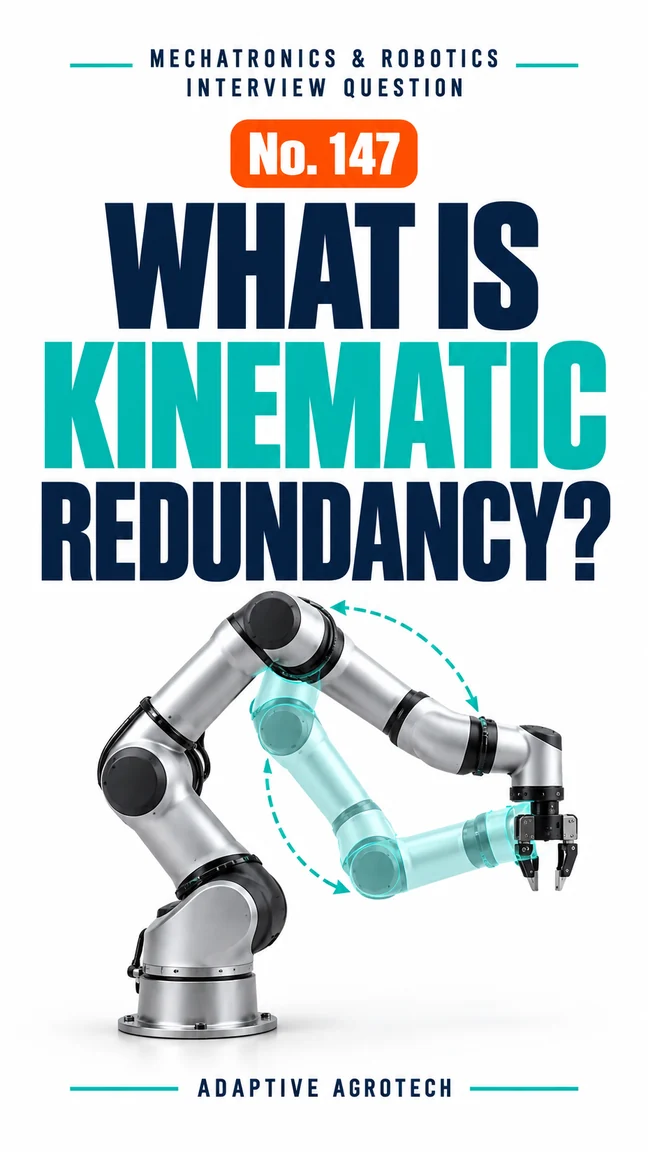
Kinematic redundancy means more independent joint motion is available than a specified task requires. It permits posture choices, but depends on task definition and Jacobian rank rather than joint count alone.
The key idea
A robot is kinematically redundant for a task when its independent joint motion exceeds what that task requires. A seven joint arm controlling a six dimensional tool pose can retain one extra direction at a regular configuration. Similarly, a three joint planar arm controlling only tool x and y can change elbow posture while reaching the same point, helping avoid a fixture or joint limit. Adding orientation as a third planar task coordinate generally removes that spare freedom. Redundancy therefore depends on the task and Jacobian rank, and all posture choices still require collision and actuator limit checks.
What to remember
- Compare independent joint freedom with the specified task.
- Spare motion can help avoid obstacles or joint limits.
- Additional task constraints can remove redundancy.
Check your understanding
Why can adding tool orientation remove redundancy from a three joint planar arm?
Show the explanation
The task then generally needs three independent coordinates instead of only the two position coordinates.